
Overgrown Fence Line in Michigan: How Wide to Clear It, and When
The Gibson Environmental Services crew
More than 10 years clearing land, cutting trails, and running forestry equipment in Southeast Michigan.
An overgrown fence line is the strip nobody mows. The wire kept the livestock on one side and the mower on the other, the birds sat on it and dropped seed, and twenty years later the fence is somewhere inside a band of brush and volunteer trees that may be five feet wide or forty. Clearing it means grinding that band back to the wire, or back to the line you flag, so the fence can be seen, reached and repaired and the mower can run along it again.
This is the hub guide for fence line work in Southeast Michigan. It covers what grows into a fence row here, how wide to open the line for each purpose with the widths in feet, how to turn a length of fence into acres, when to do the work, which service fits a fence row (forestry mulching, brush hogging or hand work), what is left behind and what grows back. Three companion guides go deeper on clearing for a new fence, pasture and horse fence lines and what sets the price; the fence line clearing service page covers how Gibson Environmental Services does the job.
Why a Fence Line Grows Shut
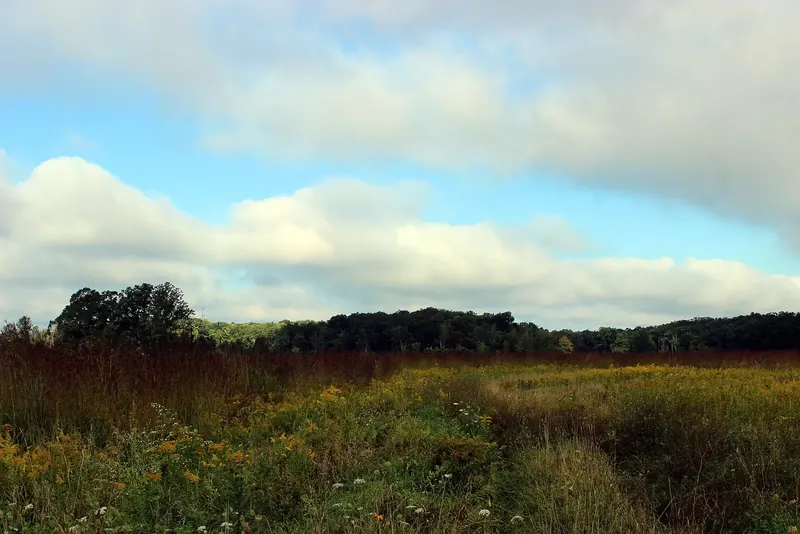
A fence row plants itself. The ecologists who study hedgerows in the Northeast describe the sequence plainly: birds favor wire fences as perches, rodents favor stone walls, and both leave seed along the line where the mower never reaches. The first arrivals are the thorny, sun-loving super-colonizers, multiflora rose and the brambles; then come the shrubs; then the weedy trees, black cherry, hawthorn, apple and elm; and finally the forest trees, maple, ash, oak and hickory, which is why a sixty-year-old fence row has real trunks in it.
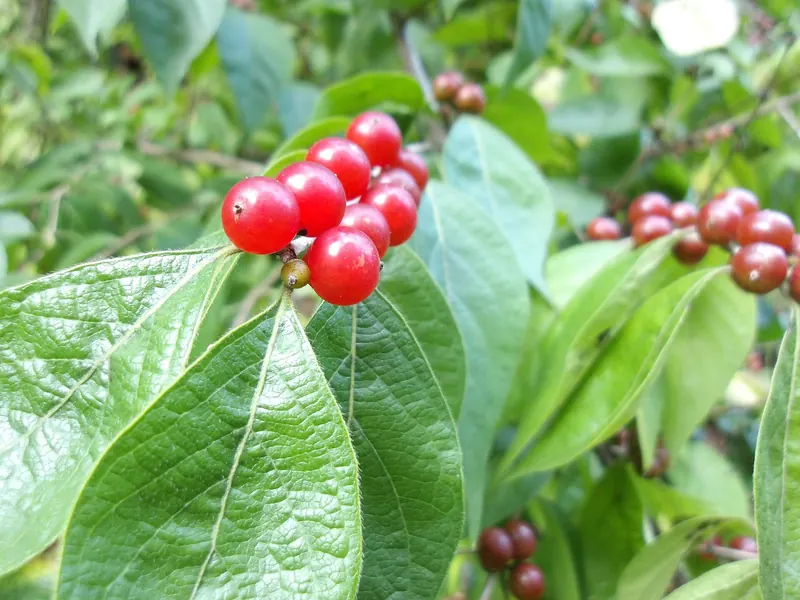
Southeast Michigan adds its own regulars. Box elder, a maple that favors disturbed sites, stream margins and the edges of woods, is the volunteer tree in most of our fence rows. Autumn olive and bush honeysuckle arrive as bird-dropped seed and form the shrub layer; common buckthorn fills the shade underneath; wild grape climbs whatever is standing and pulls wire down with its weight. Our guide to the worst invasive plants in Michigan has the identification details for each.
The practical point is that a fence row is a band, not a line. It has a length, which you can pace or read off a map, and a width it has spread to, which you measure from the first mowed grass or crop row on one side to the first on the other. Both numbers drive everything that follows.
How Wide to Clear a Fence Line: Widths by Purpose
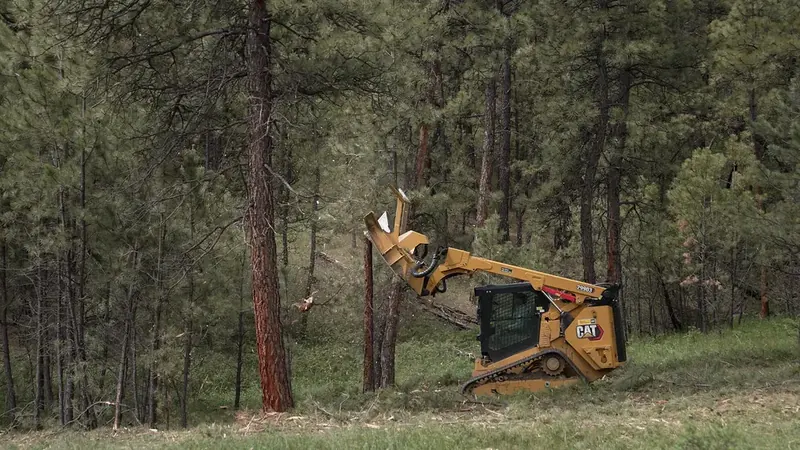
The right corridor width depends on what the line is for. The figures below come from the published widths of the machines that do the work, not from a rule of thumb: a compact track loader of the class used for this job is 78 inches (6.5 feet) wide, and the skid-steer forestry mulcher heads built for it cut a swath of 50 to 72 inches (about 4 to 6 feet) per pass. Your fence installer or surveyor sets the final number; these are the widths the arithmetic supports.
| Purpose of the line | Corridor to clear | How the width is arrived at |
|---|---|---|
| Existing fence, brush off the wire, your side only | About 4 to 6 ft on your side | One pass of a skid-steer forestry mulcher (50 to 72 in cutting width) run along the wire. |
| Existing fence, mowable on both sides | About 8 to 12 ft total, split by the fence | One mulcher pass on each side; a mower follows in the same tracks afterward. |
| Line for a new fence, posts to be set | Wider than the widest machine that will travel it; about 10 ft is the smallest sensible strip | The carrier is 6.5 ft wide; add working room on each side for the post driver or auger and for stretching wire. The installer names the number. |
| Farm fence row between two fields | The full width the row has spread to | Measure from the first crop row on one side to the first on the other; that width goes back into crop. |
| Survey line or sight line through woods | About 4 to 6 ft | One pass is enough to see the stakes and walk the line end to end. |
Two cautions. First, a corridor is measured across the line, so a wider corridor on a long fence adds acres fast; the table in the next section shows how fast. Second, the trees you want kept are flagged before the machine arrives, and the corridor bends around them; a fifty-year-old oak on the line is not brush. The guide to clearing for a new fence covers the installer's side of the width question.
From Feet to Acres: The Length-to-Acres Table
Fence lines are measured in feet and clearing is measured in acres, so the conversion matters. One acre is 43,560 square feet and one mile is 5,280 feet. Multiply the length of the line by the width of the corridor to get square feet, then divide by 43,560. A quarter mile of fence, 1,320 feet, cleared to a width of 33 feet is 43,560 square feet: exactly one acre. A full mile cleared 8.25 feet wide is also exactly one acre.
| Length of line | 8 ft wide | 10 ft wide | 12 ft wide | 16 ft wide | 20 ft wide | 30 ft wide |
|---|---|---|---|---|---|---|
| 100 ft | 800 sq ft 0.02 ac | 1,000 sq ft 0.02 ac | 1,200 sq ft 0.03 ac | 1,600 sq ft 0.04 ac | 2,000 sq ft 0.05 ac | 3,000 sq ft 0.07 ac |
| 500 ft | 4,000 sq ft 0.09 ac | 5,000 sq ft 0.11 ac | 6,000 sq ft 0.14 ac | 8,000 sq ft 0.18 ac | 10,000 sq ft 0.23 ac | 15,000 sq ft 0.34 ac |
| 1/8 mile (660 ft) | 5,280 sq ft 0.12 ac | 6,600 sq ft 0.15 ac | 7,920 sq ft 0.18 ac | 10,560 sq ft 0.24 ac | 13,200 sq ft 0.30 ac | 19,800 sq ft 0.45 ac |
| 1/4 mile (1,320 ft) | 10,560 sq ft 0.24 ac | 13,200 sq ft 0.30 ac | 15,840 sq ft 0.36 ac | 21,120 sq ft 0.48 ac | 26,400 sq ft 0.61 ac | 39,600 sq ft 0.91 ac |
| 1/2 mile (2,640 ft) | 21,120 sq ft 0.48 ac | 26,400 sq ft 0.61 ac | 31,680 sq ft 0.73 ac | 42,240 sq ft 0.97 ac | 52,800 sq ft 1.21 ac | 79,200 sq ft 1.82 ac |
| 1 mile (5,280 ft) | 42,240 sq ft 0.97 ac | 52,800 sq ft 1.21 ac | 63,360 sq ft 1.45 ac | 84,480 sq ft 1.94 ac | 105,600 sq ft 2.42 ac | 158,400 sq ft 3.64 ac |
Read the table across for the width you need and down for the length of your line. A 500-foot back line cleared 10 feet wide is 0.11 acre, a small job; a half mile of farm fence row that has spread to 30 feet is 1.82 acres, a serious one. The same arithmetic is the reason a quote must state its unit: a figure per linear foot, a figure per square foot and a figure per acre describe the same line with numbers that differ by orders of magnitude, so a number with no unit attached tells you nothing.
Forestry Mulching, Brush Hogging or Hand Work on a Fence Row
Three services clear fence lines, and most rows use two of them. The comparison is between the services, not the attachments: at Gibson Environmental Services both run on the same tracked machine.
| Service | What it takes | What it leaves | Where it fits on a fence line |
|---|---|---|---|
| Forestry mulching | Brush, vines, saplings and small trees, ground where they stand | A strip of chips over the roots, flush with the ground | The grown-in band itself: the row of box elder, autumn olive, honeysuckle and grape. |
| Brush hogging | Grass, weeds, light brush and first-year saplings, mowed | Cut material lying on open ground | The open ground on either side of the row, and the yearly pass that keeps a cleared line open. |
| Hand work | Vines on the wire, stems against posts, a few trees too big for the head | Cut material to stack or chip | The last two feet at the fence itself, and anything the machine should not touch. |
Forestry mulching does the heavy middle of the job because it grinds the stem and the root crown in one pass and leaves nothing to pile or haul; the chip strip is mowable the same day. Brush hogging is faster and lighter on ground that is still mostly grass, and it is the right follow-up in the summers after the clearing. Our forestry mulching versus brush hogging guide compares the two services in full; the brush hogging page and the forestry mulching page cover each on its own.
When to Clear a Fence Line in Michigan
Leaf-off: late fall through early spring
With the leaves down the posts, the wire and the survey stakes are visible from the seat, and the line can be followed to the inch. This is the easiest season for every kind of fence line work.
Frozen ground for the wet stretches
Fence lines follow ditches and low ground as often as not. Frozen ground carries a tracked machine across a ditch bank or a wet corner that would rut in April, so wet lines are scheduled for a hard freeze or the dry end of summer.
Outside the nesting season
Wildlife agencies recommend scheduling vegetation clearing outside the local bird nesting season, which in practice means the spring and early summer are the months to avoid on a brushy fence row, and fall and winter are the months to book.
Around the farm and the horses
A hedgerow between fields is cut after hay or after harvest so the planter is never waiting. A pasture line is scheduled around turnout, with the animals in the far paddock. A line for a new fence is cleared whenever the installer is ready to set posts, with the clearing a week or two ahead of the crew.
What Is Left Behind, and What Grows Back
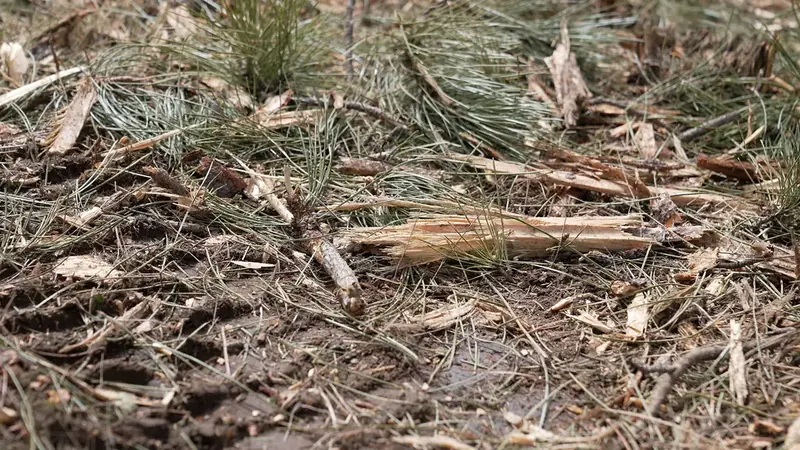
A mulched fence line is left as a strip of wood chips over roots that stay in the ground. Studies of masticated sites in the western United States measured mulch beds averaging about 3 inches deep (7.3 centimeters, with a range of 1.5 to 5 inches) across 25 sites, and found that the layer compresses and breaks down over time, fastest for the fine material. On a fence line that means a strip you can walk and mow the same day, with the chips holding the soil on a ditch bank while grass comes back through them. Our guide to what happens to the mulch covers the chip layer season by season.
What grows back is predictable. The same research found that masticated shrubs can resprout vigorously, and that on sites dominated by resprouting shrubs and hardwoods the recovery is quick unless the clearing is followed up. On a Michigan fence line the resprouters are autumn olive, box elder, honeysuckle and buckthorn, which send up shoots from the root crown in the first summer. The follow-up is simple because the strip is now mowable: a brush hog pass or two in the first two summers, run right along the wire, turns the line into grass. The species guides linked above cover the stubborn ones individually.
A Worked Example: A Quarter Mile of Grown-In Line
Take a quarter mile of old pasture fence, 1,320 feet, that has grown into a band 20 feet wide, mostly autumn olive and box elder with grape on the wire. The arithmetic: 1,320 feet times 20 feet is 26,400 square feet, which is 0.61 acre of brush to grind. If the plan is only to get the fence back, a corridor of 12 feet (one pass each side) is 15,840 square feet, 0.36 acre, and the rest of the band stays as cover. If the plan is a new fence on the same line, the installer names the strip width and the table above gives the acres.
How long that takes depends on the stems, and the published figures bracket it. In a 2010 Council on Forest Engineering study, a compact tracked carrier with a FECON drum head in dense shrub cleared 4.46 acres in 16 machine hours, a rate of 0.32 acre per productive hour, about 2.5 acres in an eight-hour working day. A contractor quoted in a 2020 Forest Service bulletin put a skid steer at a quarter to a half acre a day in heavy material. Light regrowth sits at the fast end of that range and a wire-strung row of trunks at the slow end, which is why every fence line is quoted after a look at the line rather than from a table. Send the length, the width, a photo at each end and one in the middle, and a photo of the gate or lane the machine would use.
Opening a Line for a Survey Crew or a New Fence
Two jobs call for a narrow corridor rather than a wide one. A survey crew needs to see from one point to the next and to walk the line with instruments; a single mulcher pass, about 4 to 6 feet, along the flags they set gives them both, and the stakes are left standing. A new fence needs the posts set in a straight run, so the clearing crew opens the strip the installer asks for, grinds the stumps flush so the auger or driver meets soil rather than stubs, and leaves the line walkable end to end before the fence crew arrives. The companion guide on clearing for a new fence walks through the order of work with the installer, and what sets the price of fence line clearing explains how the length, the width and the stems turn into one flat project price.
Common Questions
How wide should I clear an overgrown fence line?
For brush off an existing fence, one mulcher pass of about 4 to 6 feet on your side; for a line mowable on both sides, about 8 to 12 feet split by the fence; for a new fence, a strip wider than the widest machine that will travel it, which the installer specifies. A farm fence row between fields is cleared to the full width it has spread to.
How many acres is a quarter mile of fence line?
It depends on the width. A quarter mile is 1,320 feet; at 10 feet wide that is 13,200 square feet or 0.30 acre, at 20 feet wide 0.61 acre, and at 33 feet wide exactly one acre (43,560 square feet). The table in this guide lists six lengths and six widths.
What is the best time of year to clear a fence line in Michigan?
Late fall through early spring, with the leaves down so the posts, wire and stakes are visible, and with frozen ground for the wet stretches. Avoid the spring and early summer nesting season on a brushy row. Farm rows are cut after hay or harvest; pasture lines are scheduled around turnout.
What plants take over a fence line in Michigan?
Multiflora rose and brambles come first, then shrubs such as autumn olive and bush honeysuckle, then volunteer trees: box elder, black cherry, hawthorn and elm, with buckthorn in the shade underneath and wild grape on the wire. Given long enough, maple, ash and oak follow.
Should a fence row be mulched or brush hogged?
Both, usually. Forestry mulching grinds the grown-in band of brush and saplings where it stands and leaves a chip strip; brush hogging mows the open ground beside it and is the yearly pass that keeps the cleared line open. Hand work handles the last two feet at the wire.
What is left after a fence line is mulched?
A strip of wood chips a few inches deep over roots that stay in the ground. It is walkable and mowable the same day, there is no pile to burn or haul, and the chips hold the soil on a bank while grass comes back through them.
Will the brush grow back along the fence?
Some of it will sprout from the roots in the first summer, autumn olive, box elder, honeysuckle and buckthorn especially. A brush hog pass or two along the wire in each of the first two summers finishes the job, and the chip strip makes that mowing easy.
Can the fence stay up while the line is cleared?
Yes. The forestry mulcher works along the wire on your side, the posts and wire you flag stay where they are, and the vines come off the fence as the brush around them comes down. Once the strip is clear you can see every section that needs repair.
What should I send for a fence line quote?
The length of the line, how wide it has grown, a photo at each end and one in the middle, a photo of the gate or lane the machine would use, and a note on what is on the line: old wire, posts, stones, trees to keep. That is enough for one flat project price.
Sources and Further Reading
The width figures are machine specifications from the manufacturers; the acre arithmetic uses the standard conversions; the ecology, timing and regrowth statements come from the published research and agency guidance below.
Farmscape Ecology Program, Hawthorne Valley: Hedgerows: how fence rows develop and which species colonize them
Missouri Department of Conservation: Box elder (Acer negundo) field guide: habitat on disturbed sites and wood edges
National Institute of Standards and Technology: Unit conversion factors: 1 acre = 43,560 square feet, 1 mile = 5,280 feet
U.S. Fish and Wildlife Service: Timing recommendations for land disturbance and vegetation clearing: protecting nesting birds
Joint Fire Science Program: Longevity and effectiveness of mechanical mastication treatments (mulch depth and resprouting)
Council on Forest Engineering, 2010 proceedings: Establishing a standard work sampling method for mastication operations analysis (0.32 acre per productive hour)
USDA Forest Service, Rocky Mountain Research Station: Is mastication right for your site? Science You Can Use bulletin
Kirby-Smith Machinery: FECON Bull Hog skid steer mulcher specifications: 50, 61 and 72 inch working widths
Bobcat Company: T86 compact track loader specifications: 78 inch overall width
Where We Do This Work
The work in this guide is done across eight Southeast Michigan counties from our base in Royal Oak. Every county page lists the townships we work in most, with a page for each.
Have an Overgrown Fence Line?
Send the length of the line, how wide it has grown and a few photos, and Gibson Environmental Services will send back one flat project price for the whole line, travel included.