Bush Honeysuckle in Michigan: How to Identify It and Clear It From a Woodlot or Fence Row
The Gibson Environmental Services crew
More than 10 years clearing land, cutting trails, and running forestry equipment in Southeast Michigan.
Bush honeysuckle is the shrub that fills the understory of a woodlot until nothing else grows there. It leafs out before the trees do, holds its leaves after they drop, and carries pairs of red berries along every branch from midsummer on. Four kinds grow wild in Michigan, and all four behave the same way.
This guide covers how to identify bush honeysuckle, how to tell the four species apart, which native shrubs get mistaken for it, and what it takes to clear a thicket so the woods can grow back. It is one of the plants in our ten worst invasive plants guide.
The Four Bush Honeysuckles at a Glance
| Amur | Tatarian | Morrow's | Bell's | |
|---|---|---|---|---|
| Scientific name | Lonicera maackii | Lonicera tatarica | Lonicera morrowii | Lonicera x bella |
| Height | To 16 feet | To 12 feet | To 6 feet | To 10 feet |
| Leaves | 1.5 to 3.5 inches, long pointed tip | 1 to 2.4 inches, hairless | 1 to 2.4 inches, gray-green, softly hairy beneath | Oval, slightly hairy beneath |
| Flowers | White to pink | Pink to white, sometimes red | White | Pink |
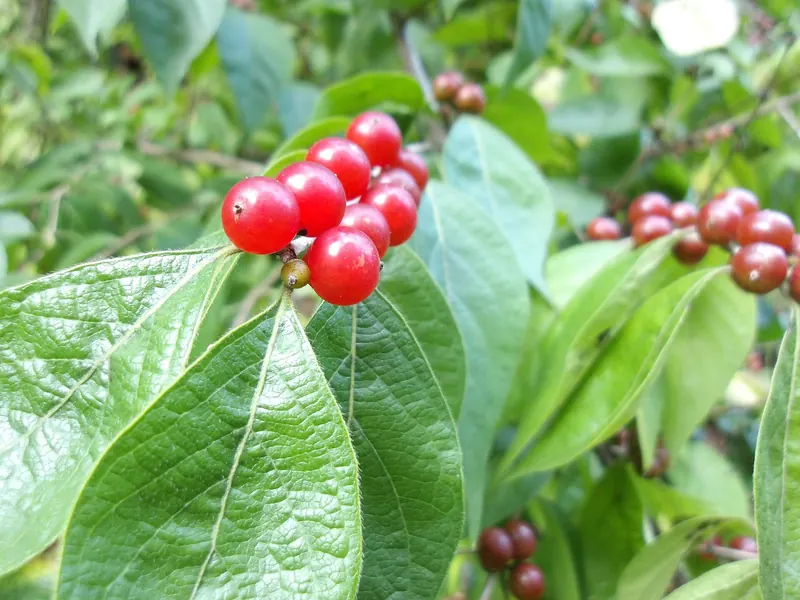
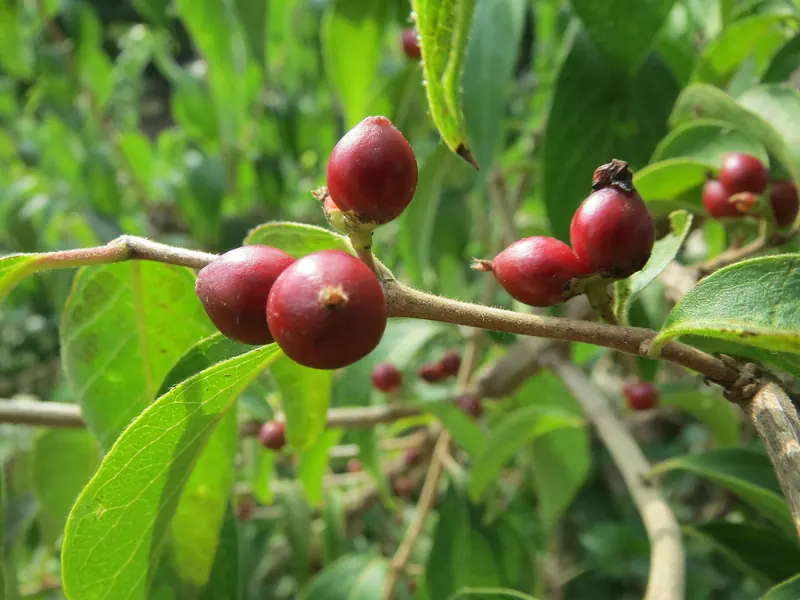
| Berries | Red, tight to the twig | Red or orange | Red | Red |
| Native to | Asia | Eurasia | Japan | A cross of Tatarian and Morrow's |
What All Four Have in Common
Opposite leaves with smooth edges
The leaves sit in pairs, directly across from each other on the twig, and the edges are smooth with no teeth. They come out early in spring, before the native shrubs, and hang on late in fall.
Flowers and berries in pairs
Small, tubular, fragrant flowers open in pairs from May into June, where the leaf meets the twig. The berries that follow are paired too, red or orange, and many stay on the branch into winter.
Arching stems
Each shrub is a clump of many stems with long, arching branches. The bark is gray to tan: ridged on Amur honeysuckle, shaggy and peeling on the others.
The hollow stem test
Cut an older branch. The invasive bush honeysuckles are often hollow between the joints, with a brown center. The native honeysuckles are solid.
The April test
In April a woodlot with honeysuckle in it is green from knee height to head height while the rest of the woods is still bare. It is the easiest time of year to see how much is there.
What Gets Mistaken for Bush Honeysuckle
Native honeysuckles
Michigan has native honeysuckles, among them Canada honeysuckle and the fly honeysuckles. They are short and sparse next to the invasive ones, and their older stems are solid, not hollow.
Dogwoods
Opposite leaves with smooth edges, like honeysuckle. Dogwood flowers and berries sit in clusters at the ends of the branches, not in pairs along them.
Autumn olive
Red berries in fall, but the leaves alternate along the twig and are silvery underneath. The autumn olive guide covers it.
Why Bush Honeysuckle Takes Over
It was planted on purpose
Bush honeysuckles were recommended for wildlife plantings and sold as yard shrubs, which is why they are as common at the edge of town as they are in the country.
A longer season
It leafs out early and keeps growing late, so it shades the woods floor during the weeks when spring wildflowers and tree seedlings need the light.
Birds move the seed
The fruit is abundant and birds carry it, so new shrubs come up under every perch: fence lines, power lines and the edge of the woods.
Sun or shade
It tolerates sun and shade and a wide range of soil and moisture, so it moves from the fence row into the woods behind it.
It comes back from the roots
A cut stump resprouts, and so can pieces of root left in the ground.
The woods stop replacing themselves
A thicket keeps tree seedlings from getting started. As the old trees come down, there is nothing under them but honeysuckle.
How to Remove Bush Honeysuckle, by the Size of the Problem
Small plants
Bush honeysuckle is shallow-rooted. Small plants pull or dig easily when the soil is moist. Get all of the root, because pieces left behind can resprout.
A few shrubs along a yard or fence
Cut them at the ground, the largest fruiting shrubs first. A cut stump resprouts, so plan on a stump treatment at the time of cutting, or on cutting the sprouts back until the root is spent.
A thicket in a woodlot or along a fence row
This is forestry mulching work. The trees you want to keep are flagged before the work starts, and the mulching head grinds the honeysuckle and its root crowns to the ground between them, leaving a chip layer: no brush piles, nothing hauled and nothing burned. The forestry mulching page explains the method and the invasive growth removal page covers the day on site.
After the clearing
Sunlight reaches the ground again. Mowing the open ground, and a walk through the woods each spring to pull seedlings, keeps it from closing back in.
The Follow-Up Plan
| When | What the honeysuckle does | What keeps it down |
|---|---|---|
| The day it is cleared | The thicket is ground to a chip layer | The woods floor is open and walkable |
| First spring | Seedlings and sprouts show green before anything else | Walk it in April, when they are easy to see; pull or cut them |
| Next summer | The larger stumps send up sprouts | A follow-up pass or a stump treatment |
| Every year after | Birds bring in new seed | A walk-through each spring |
When to Remove Bush Honeysuckle in Michigan
Early spring and late fall are when it is easiest to see, because it is green when the woods around it are not.
Summer and fall are fine for fence rows and upland woods. Clearing before the berries ripen keeps that year's seed out of the woods.
Winter on frozen ground is the time for low woods and wet edges.
What Bush Honeysuckle Removal Costs
Every job is one written project price, from photos or a walk-through, with the size of the area, the density of the thicket, the terrain and the travel built in. The pricing guide explains what moves the number.
Common Questions
How do I tell invasive honeysuckle from a native one?
Size and the stem. The invasive bush honeysuckles are large, dense shrubs from six to sixteen feet tall, and their older branches are often hollow. Native honeysuckles are short and sparse, with solid stems.
Will bush honeysuckle grow back after forestry mulching?
Some stumps will sprout, and seedlings come up where the light reaches the ground. One follow-up the next summer handles most stands. Plan on one to two seasons.
Is this the same as the honeysuckle vine?
No. The bush honeysuckles in this guide are upright shrubs with many stems. Honeysuckle vines climb and twine; they are a different plant.
Can you clear honeysuckle and leave the trees?
Yes. The trees you want to keep are flagged before the work starts and the mulcher works between them.
What is the best time of year to clear bush honeysuckle?
Any time the ground will carry the machine. It is easiest to see in early spring and late fall, and clearing before the berries ripen keeps the seed out of the woods.
Can you tell what I have from photos?
Usually. Send a close photo of a leaf, one of a twig or cane, and one of the whole stand, and we will tell you what it is and how we would clear it.
Sources and Further Reading
The identification details and figures in this guide come from published university and state references. These are the ones to read for more depth.
University of Michigan Herbarium, Michigan Flora: Amur honeysuckle, Tatarian honeysuckle and Morrow honeysuckle
Michigan Natural Features Inventory, Michigan State University Extension: A Field Identification Guide to Invasive Plants in Michigan's Natural Communities
Penn State Extension: Shrub honeysuckles
Where We Do This Work
The work in this guide is done across eight Southeast Michigan counties from our base in Royal Oak. Every county page lists the townships we work in most, with a page for each.
Honeysuckle Filling In a Woodlot or a Fence Row?
Send a few photos of the growth and the address. We will tell you what it is, how we would clear it, and give you one written price for the job.