
Buckthorn in Michigan: How to Identify It, Why It Spreads, and How to Remove It for Good
The Gibson Environmental Services crew
More than 10 years clearing land, cutting trails, and running forestry equipment in Southeast Michigan.
If a corner of your property is still green in November, when the maples and oaks around it are bare, you are probably looking at buckthorn. It is the invasive shrub we clear most often in Oakland, Lapeer, Livingston and Macomb counties, and it turns up in the same places every time: fence rows, woodlot edges, the back of a lake lot, the strip between a subdivision and the woods behind it.
This guide is about buckthorn and nothing else: how to tell common buckthorn from glossy buckthorn, which native shrubs get mistaken for it, why a few shrubs turn into a thicket, and what it takes to remove it so it stays gone. If you are dealing with more than one invasive, the worst invasive plants guide covers the other nine.
Buckthorn at a Glance
Two species are loose in Michigan. They are related, they behave the same way, and they are removed the same way, but they look different and they favor different ground.
| Common buckthorn | Glossy buckthorn | |
|---|---|---|
| Scientific name | Rhamnus cathartica | Frangula alnus |
| Size | Shrub or small tree, 10 to 25 feet | Shrub or small tree, to about 18 feet |
| Leaf edge | Finely toothed | Smooth, no teeth |
| Leaf veins | 3 to 5 pairs, curving toward the tip | 8 or 9 pairs, close together |
| Twig tip | Often a short, sharp thorn | No thorn |
| Flowers | Four petals, May and June | Five petals |
| Fruit | Green, ripening to purplish black | Green to red to dark purple |
| Favorite ground | Fence rows, old fields, roadsides, woodlots | Wet ground: pond edges, ditches, wet woods |
How to Identify Common Buckthorn
The leaves
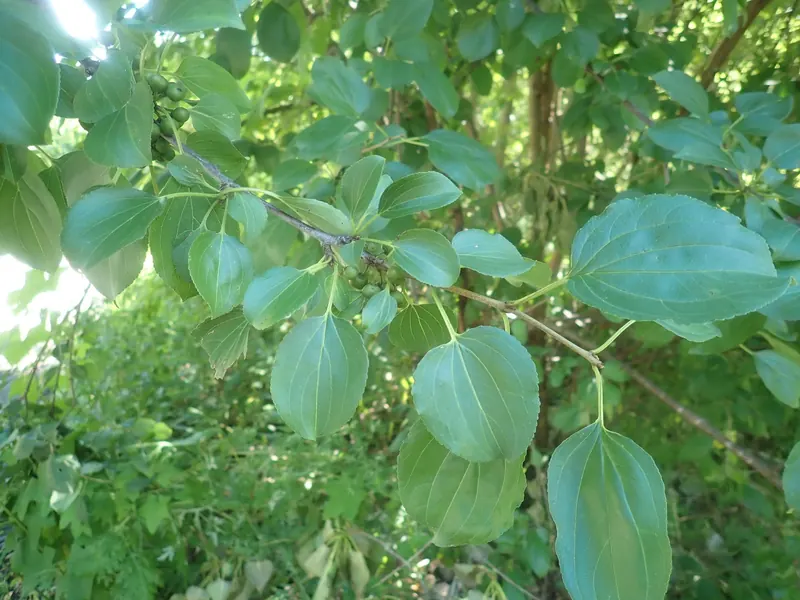
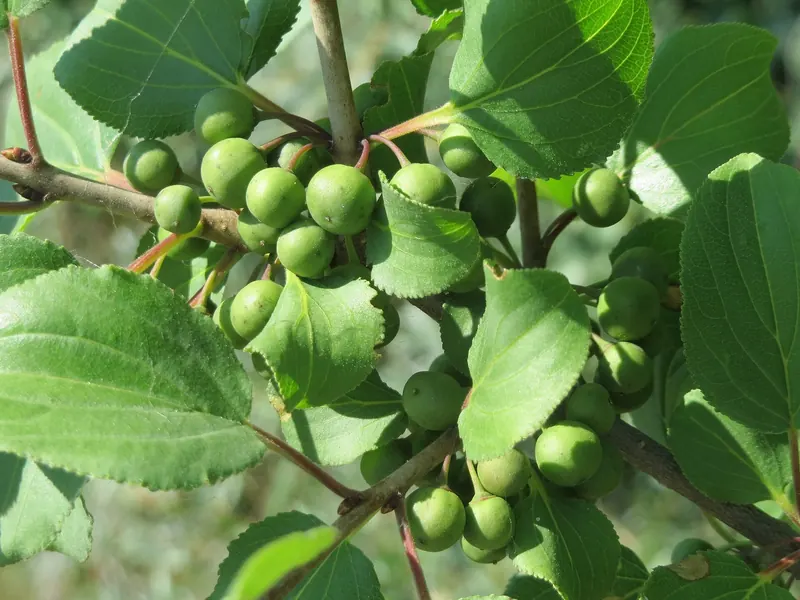
Dark green and oval with a finely toothed edge. The giveaway is the veins: three to five pairs that curve toward the tip of the leaf. The leaves sit almost opposite each other on the twig, but not quite.
The twig tips
Many twigs end in a short, sharp thorn sitting between the last two buds. It is the reason clearing buckthorn by hand is slow work.
The bark
Gray-brown and peeling on older stems, with light raised marks dotted along the branches. Scrape it with a thumbnail or a knife and the inner bark is orange.
The fruit
Pea-sized berries clustered along the stem, green through the summer and purplish black by fall, on female shrubs only. Many of them hang on into winter.
The November test
Buckthorn leafs out before most native shrubs and holds green leaves weeks after they have dropped theirs. From late October through November, anything still green at the edge of the woods deserves a closer look.
Glossy Buckthorn: the One in the Wet Ground
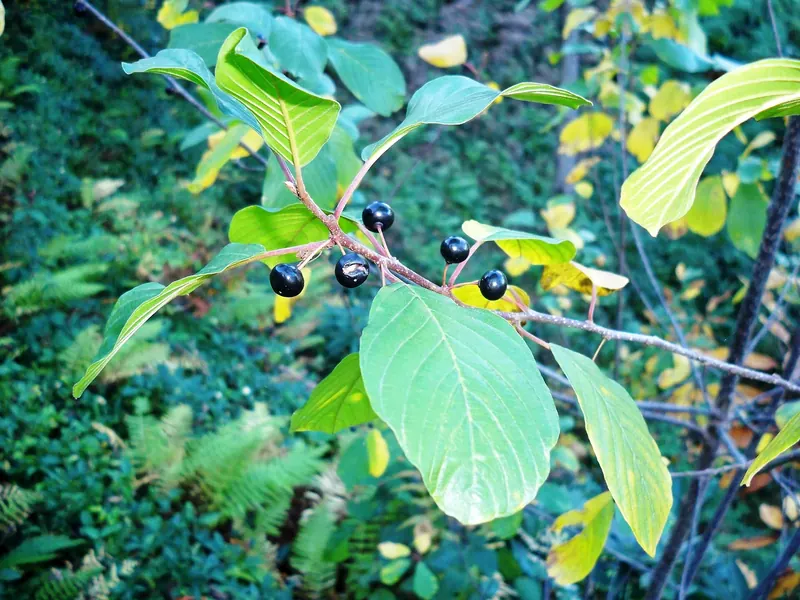
Glossy buckthorn is the same problem on wetter ground. The leaves are shiny with a smooth edge and eight or nine pairs of veins, the twigs carry no thorn, and the flowers have five petals instead of four. The fruit ripens from green to red to dark purple over the summer, so one shrub often carries more than one color at a time.
It is the buckthorn on pond edges, along ditches and in wet woods, and it is cleared the same way as common buckthorn. The difference is timing: wet ground is worked when it is frozen, or in the dry weeks of late summer.
What Gets Mistaken for Buckthorn
Wild cherry
Black cherry and chokecherry have finely toothed leaves too, but the veins run straight out to the edge instead of curving to the tip. The bark is marked with short horizontal lines, and a scratched twig smells of bitter almond.
Dogwoods
Dogwood veins curve toward the leaf tip the way buckthorn veins do, which is where the confusion starts. Dogwood leaves sit truly opposite each other and have a smooth edge, the stems are often reddish, and the fruit is blue or white rather than black.
Alder-leaved buckthorn
A native relative, under three feet tall, that grows in fens and other wet places. Its leaves have tiny rounded teeth and six or seven pairs of veins. It is worth leaving where it grows.
Not sure which one you have? Send photos of a leaf, a twig tip and the bark. That is usually enough to tell.
Why a Few Shrubs Become a Thicket
A longer season
Buckthorn leafs out early and holds its leaves late, so it shades out the spring wildflowers and tree seedlings under it for most of the year.
Fruit, and birds to carry it
Female shrubs can start fruiting at about four years old. Birds, deer and mice move the seed, and much of the fruit simply drops under the shrub and comes up as a carpet of seedlings.
A seed bank
Buckthorn seed stays alive in the soil for two to six years. Under a mature stand there can be 500 to 1,000 seeds in every square meter of soil, which is about eleven square feet.
It resprouts
Cut a buckthorn and it comes back from the stump and the roots with more stems than it had before.
It changes the soil
The leaves and fruit are rich in nitrogen and break down fast, which leaves bare soil under the stand: the seedbed buckthorn seedlings like best.
It is hard on the field next door
Common buckthorn is a winter host for soybean aphid and carries the crown rust that hits oats, so a fence row full of it is a farm problem as well as a woods problem.
How to Remove Buckthorn, by the Size of the Problem
Seedlings and knee-high plants
Pull them by hand when the soil is moist. Pull slowly and steadily so the root comes with it, and press the soil back down afterward. A lever-type pulling tool handles stems a little bigger.
A few shrubs along a yard or fence
Cut them at the ground. A cut stump resprouts, so plan on a stump treatment at the time of cutting, or on cutting the sprouts back each summer until the root is spent.
A thicket, a fence row or acres of it
This is forestry mulching work. We run a FECON mulching head on a high-flow tracked skid steer that grinds the stems and the root crowns to the ground and leaves a chip layer behind: no brush piles, nothing hauled and nothing burned. The forestry mulching page explains the method, and the invasive growth removal page covers the day on site.
Keeping the ground open afterward
Mowing once or twice a year keeps buckthorn seedlings from establishing on cleared ground. On acreage that is a brush hogging pass; on a fence row it is a mower.
The Follow-Up Plan
Clearing the stand is the first day of the job, not the last. This is what the seasons after it look like.
| When | What the buckthorn does | What keeps it down |
|---|---|---|
| The day it is cleared | The stand is ground to a chip layer and sunlight reaches the soil | The chips hold the soil and slow the first seedlings |
| First summer | Some stumps resprout; seedlings come up from the seed bank | A follow-up pass on the resprouts; mow the seedlings |
| Second summer | Fewer resprouts, another flush of seedlings | A second follow-up; grass and native cover start to fill in |
| Years three to six | The seed bank runs down | One mowing or walk-through a year; pull the stragglers |
The long tail is the seed. It lasts two to six years in the soil, so the ground has to be kept from going back to seed for that long. If a neighboring fence row is full of fruiting buckthorn, the birds will keep bringing it, and a yearly mowing is what holds the line.
When to Remove Buckthorn in Michigan
Late October through November is the best window. Buckthorn is still green after the native shrubs have dropped their leaves, so every plant in the stand is easy to see, and the ground is firm.
Winter on frozen ground is the time for glossy buckthorn on wet sites: pond edges, ditch banks and wet woods, where the tracked machine rides on the frost.
Spring and summer work well for upland fence rows and field edges. Clearing before the fruit ripens in late summer keeps that year's seed off the ground.
What Buckthorn Removal Costs
Every job is one written project price, from photos or a walk-through, with the density of the stand, the terrain, the access and the travel built in. Follow-up visits are priced the same way. The pricing guide explains what moves the number.
Common Questions
How do I tell buckthorn from wild cherry?
Look at the veins and the twig. Buckthorn leaves have three to five pairs of veins that curve toward the tip of the leaf, many twigs end in a short thorn, and the inner bark is orange. Cherry veins run straight out to the leaf edge, the bark is marked with short horizontal lines, and a scratched twig smells of bitter almond.
Will buckthorn grow back after forestry mulching?
Some of it will try. Mulching grinds the stems and root crowns to the ground, and a share of the stumps send up sprouts the next summer. A follow-up pass handles those, and mowing keeps the seedlings from taking hold. Plan on two to three seasons to finish a stand.
How long do buckthorn seeds last in the soil?
Two to six years. That is why the follow-up matters as much as the clearing: the ground has to be kept from going back to seed until the seed already in the soil has run out.
What is the best time of year to remove buckthorn?
Late October through November. Buckthorn is still green after the native shrubs have dropped their leaves, so the whole stand is easy to see, and the ground is firm. Wet sites are cleared on frozen ground in winter.
Is glossy buckthorn removed differently?
The method is the same. The timing changes, because glossy buckthorn grows in wet ground: pond edges, ditch banks and wet woods are cleared on frozen ground in winter or in the dry weeks of late summer.
Can you tell what I have from photos?
Usually. Send a close photo of a leaf, one of a twig tip and one of the bark, plus a photo of the whole stand, and we will tell you what it is and how we would clear it.
More on invasives: the buckthorn and autumn olive removal guide and the ten worst invasive plants in Michigan.
Where We Do This Work
The work in this guide is done across eight Southeast Michigan counties from our base in Royal Oak. Every county page lists the townships we work in most, with a page for each.
Buckthorn Taking Over a Fence Row or a Woodlot?
Send a few photos of the growth and the address. We will tell you what it is, how we would clear it, and give you one written price for the job.