
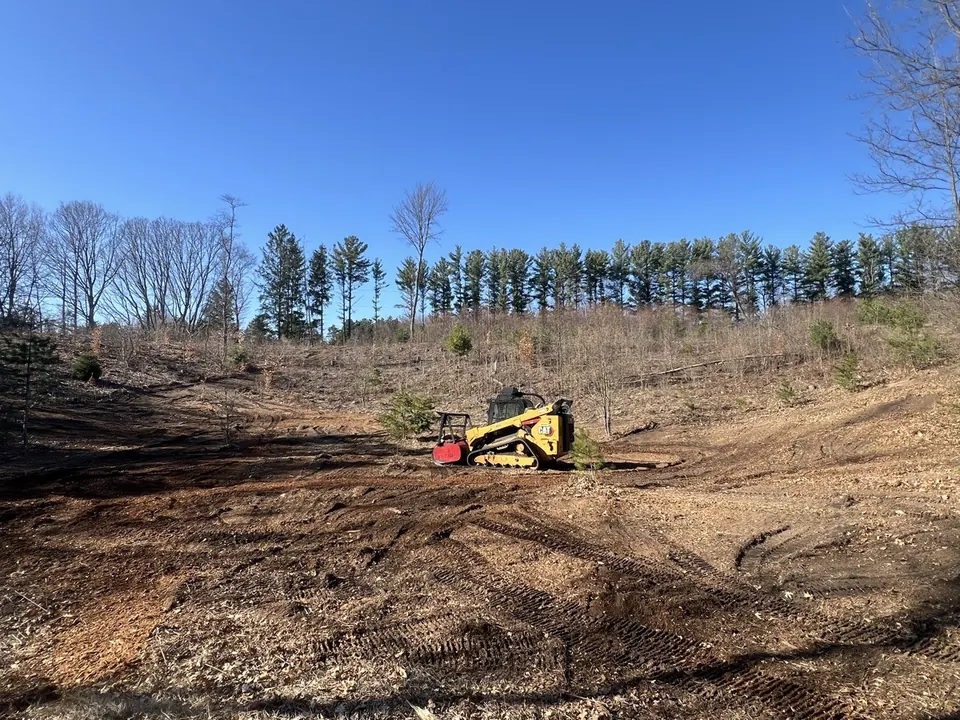
A food plot starts as a mulching job, not a planting job. Half-acre pockets tucked into the timber and one- to two-acre kidney- and hourglass-shaped plots on field edges across Lapeer County's Almont and Imlay City areas, Livingston County's Fowlerville and Pinckney townships and St. Clair County's Kimball Township all begin the same way: brush, saplings and old fence rows ground down to a chip layer a disk can run through. A dozed plot pushes topsoil into a windrow at the edge and leaves subsoil in the middle; a mulched plot leaves the topsoil exactly where it was, which is most of the difference in what comes up the first season. That difference shows up within weeks of planting, in how evenly a stand comes up across the whole plot instead of thick in some corners and bare in others.
The shape of the plot is laid out before the machine starts, not cut square because square is easy. Kidney and hourglass shapes with a screen of standing brush at the waist give a deer a reason to commit past the edge instead of feeding nervously in the open, and a strip of edge cover is left around the whole perimeter on purpose. Wet corners are planned for rather than plowed through: a low spot that holds water into June is routed around or left out of the plot entirely, so the rest of the ground is not compromised trying to save a few hundred square feet. Access for a tractor or an ATV is opened at the same time, wide enough to get equipment in without dragging it through the plot itself.
Timing runs on the calendar, not the forecast. Spring plots are cleared in April so the ground has a full growing season ahead of it; fall plots need to be cleared by early August so there is time for the chip layer to settle and for a disk to work before planting. Clearing a plot site is usually done on the same visit as shooting lanes and access trails on the same parcel, since the machine and the trip out are already paid for once. Our food plot guide covers layout and timing in more depth, and hunting land clearing covers the rest of the property. Send a sketch of where you want the plot and we will price it from that.
What we clear
- Half-acre pockets in the timber and one- to two-acre plots on field edges, cleared to the shape you sketch.
- Kidney and hourglass outlines with a screen of standing brush left at the waist.
- Old fence rows and hedgerows on the plot boundary, ground back to the line.
- Edge cover left standing around the perimeter so the plot reads as an opening, not a clearing.
- Tractor or ATV access into the plot, wide enough to run equipment without crossing the planting area.
- Brush and saplings inside the plot outline, ground to a chip layer a disk can run through.
What you get
- A plantable chip layer, ready for your disk and seed.
- Topsoil where it was, not windrowed at the edge the way a dozed plot leaves it.
- Screening cover standing at the waist of a kidney or hourglass shape and around the perimeter.
- Access wide enough for a tractor or an ATV, without a path cut through the middle of the plot.
How the Job Goes
Sketch the shape
A kidney, hourglass or simple block, sized to the ground you have and the access you want in.
Walk the wet corners
Low spots that hold water into early summer are flagged to route around or leave out.
Clear to a chip layer
The mulcher grinds the outline and the access lane in one visit, leaving a plantable surface.
Hand it off ready to work
The plot is left as a chip layer that settles into a seedbed a disk can run through.
When to do it
Spring plots are cleared in April, giving the ground a full season before planting. Fall plots need to be cleared by early August so the chip layer has time to settle before a disk goes in. Clearing a plot site alongside lanes or trails on the same visit is the most efficient way to do all three, since the machine is already on the property.
How it is priced
Priced by the project: plot size, shape and how dense the ground is, plus any access lane, with travel included in one written price. Plots cleared alongside lanes or trails on the same parcel are quoted together. The pricing guide explains what moves the number.
The Ground This Work Happens On


Where We Do This Work
Counties and townships where this job comes up most. Every page covers the local ground and the common jobs.
Questions About This Work
Do you plant the plot or just clear it?
We clear and mulch the site to a plantable chip layer, shaped the way you want it, and ready for your disk and seed. Getting the ground to that point, brush gone, topsoil intact, edges shaped, is the part a mulcher does better than a dozer, and it is the part of the job that is ours.
Why does a mulched plot grow better than a dozed one?
A dozer pushes topsoil into a windrow at the edge of the plot and leaves the thinner subsoil in the middle, which is exactly where you want the best growth. Mulching grinds the brush in place instead of pushing it, so the topsoil stays where it was and the seedbed underneath is the good ground you started with.
What if part of the plot is wet?
Wet corners are walked and flagged before the machine starts. A low spot that holds water into June is usually routed around or left out of the plot rather than worked, since planting into it is wasted seed most years. The rest of the plot is shaped around it.
Can you clear the access lane at the same time?
Yes. A lane wide enough for a tractor or an ATV is cut as part of the same visit, routed so equipment reaches the plot without ever crossing the planting area itself. It is priced with the plot as one project.
Other jobs we do
Related Guides
Food Plot Clearing in Michigan: How to Turn Overgrown Ground Into a Plantable Deer Plot
Clearing land for a deer food plot in Southeast Michigan: mulching vs.
Read the guide →
Hunting Trail Clearing in Michigan: Access Trails, Shooting Lanes, and Stand Approaches Before Deer Season
Hunting trail and shooting lane clearing in Southeast Michigan. Quiet trails mulched in place, no burn pile, done before the October 1...
Read the guide →
What Happens After Forestry Mulching? Timeline, Mulch Breakdown, and Grass Regrowth, Month by Month
What happens after forestry mulching: how fast the mulch breaks down, when grass comes back, and how to manage regrowth on cleared...
Read the guide →Ready to Get This Done?
Send the address and a few photos through the quote form, or call. You will get one project price for the whole job.