
Dead Ash Trees on Your Michigan Land: Why They Are Dangerous, How Long They Stand, and What to Do With Them
The Gibson Environmental Services crew
More than 10 years clearing land, cutting trails, and running forestry equipment in Southeast Michigan.
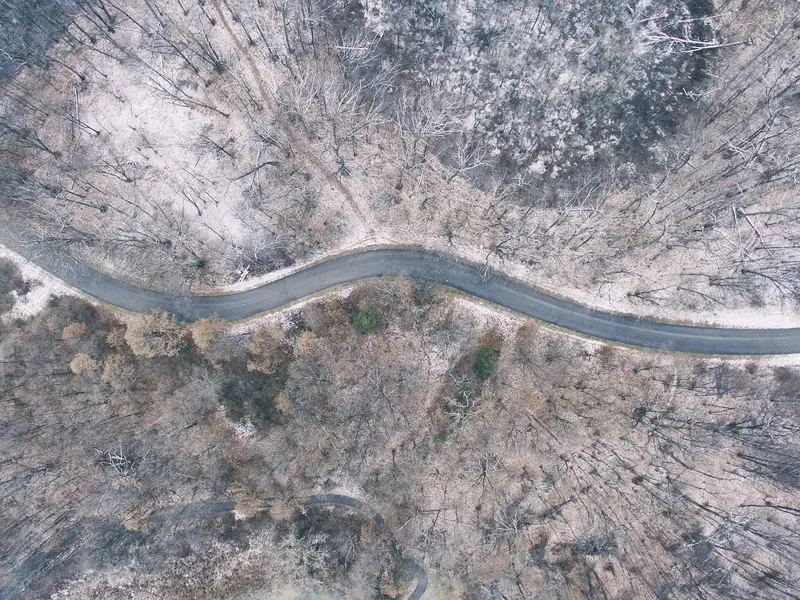
Dead ash trees should come down wherever anyone walks, drives, parks, hunts or builds, and they should come down sooner rather than later, because dead ash is the one tree in a Michigan woodlot that breaks without warning. The emerald ash borer was first found in North America in the Detroit area in 2002, Southeast Michigan has lived with it longer than anywhere else, and most of the ash on an Oakland, Macomb, Wayne or Lapeer County property died in the years after 2005. Many are still standing, gray and barkless, over trails, fence lines, drives and stands.
This guide covers how to recognize borer damage on an ash that is still alive, why a dead ash is more dangerous than a dead oak, how long it stays up, what the wood is still good for, and how we take standing dead ash down on acreage as part of a forestry mulching or land clearing pass. It is written for landowners with a woodlot or a fence row full of them, not for the single yard tree, which is an arborist's job.
How to Tell the Borer Got to a Living Ash
The state forest-health programs list the signs, and they show up in this order on most trees. Look for at least two before you conclude anything, because other problems mimic each one on its own.
- Thinning at the top: the crown goes sparse from the top down, usually one to three years after the beetle arrives.
- Woodpecker flecking: patches of outer bark stripped pale where woodpeckers dug for larvae, starting high and working down. In winter it is the easiest sign to see from the ground.
- D-shaped exit holes about an eighth of an inch across, flat on one side. Round holes a quarter inch and bigger are native borers, not this one.
- Vertical bark splits over the larval tunnels, with the S-shaped, sawdust-packed galleries visible underneath when the bark is peeled.
- Sprouts from the trunk and the base: the tree's last attempt to grow leaves below the damage.
The extension guides put the time from infestation to death at a few years, two to six depending on the tree. By the time the top is bare the tree is on its way out, and in Southeast Michigan, where the wave passed fifteen years ago, an ash with a full crown today is a survivor worth leaving alone.
Why Dead Ash Is the Most Dangerous Tree on the Property
The extension educators who followed ash breakage years after the borer explain the mechanism: once the tree is dead, wood-rotting fungi break down the fibers that hold the trunk and limbs together, ash has little natural resistance to that decay once the bark is gone, and the result is a tree that keeps shedding limbs and whole tops for a number of years after it dies. The limbs come down on calm days as well as windy ones, and a trunk that looks solid from the ground is often hollow and punky a few feet up.
A dead oak stands for decades and warns you with a lean or a conk. A dead ash gives no warning, which is why we treat every standing dead ash near a target as the first thing to deal with on a site, and why the same educators makes the point that even the chainsaw work on an unstable ash is dangerous and best left to people who do it every week. Our guide to rotten and hazard tree signs explains the target idea: a dead tree deep in the woods with nothing under it is habitat, and a dead tree over a trail is a job.
How Long a Dead Ash Stays Standing
No extension office gives a number, and the honest answer is that it comes apart in stages rather than falling at once. The fine branches go in the first year or two. The top and the big limbs follow, which is the dangerous stage, because it can last for years and the pieces are heavy. The trunk is the last to go, and a trunk with the bark off and the sapwood soft can stand a long time while it rots from the base. Across our counties, most of the standing dead ash we work around has been dead for well over a decade and is in that last, trunk-only stage, which is also the stage where the trunk is lightest and easiest to take down.
The scale of it is why this is a clearing question and not a tree-service question: the extension bulletin on dead ash for this region was written for a region where the dead trees number in the tens of millions, and a typical ten-acre woodlot here has dozens of them. That is a machine job.
What to Do With Dead Ash, by Where It Stands
| Where the dead ash is | What to do | Why |
|---|---|---|
| Over a drive, a trail, a lane, a parking spot or a building | Take it down first, before anything else on the site | It is the tree most likely to drop something on someone, and it needs no wind to do it |
| Along a fence line | Take it down as part of the fence row clearing | A dropped ash limb takes the wire with it; see overgrown fence line clearing |
| Over a deer stand, a blind or a shooting lane | Take it down before the season | You sit under it for hours at a time; see hunting land clearing |
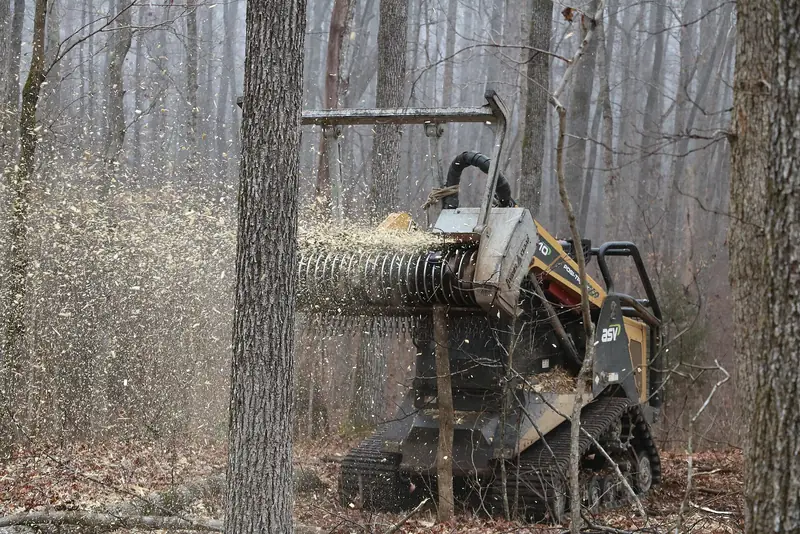
| In a woodlot being thinned or cleared | Mulch it with the rest | Dead ash of mulchable size grinds where it stands; larger trunks are felled first |
| Deep in the woods, nothing under it | Leave a few as snags | Cavity trees for woodpeckers, owls and squirrels; standing dead wood is habitat where it threatens nothing |
| A single ash in a yard near the house | Call an arborist | A rigged removal between a house and a garage is their trade |
How We Take Down Dead Ash on Acreage
Walk and mark in leaf-off
Dead ash is easiest to find from late fall through March, when the gray, barkless trunks stand out against the live trees. We flag them on the walk-through and plan the fall zones around what you want kept.
Mulch what the mulcher can reach
Dead ash of mulchable size is ground where it stands with the forestry mulcher, trunk, limbs and stump, and spread as chips. Dead wood is drier and lighter than live wood, so it goes faster than a live tree of the same size.
Fell the big ones first
Larger trunks are dropped into the clearing, away from keeper trees and anything you care about, and then mulched or cut to firewood length and left where you want them.
Frozen ground is the best ground
Winter puts the machine on firm footing in wet woodlots and keeps the ruts out; it is our busiest season for this work. See fall and winter land clearing.
Leave the habitat trees
A few dead ash away from any target stay as snags. We mark those with you too.
Nothing on a dead-ash job gets piled or burned unless you want firewood; the chips stay on the ground and the woodlot is open and walkable the day we leave. Our guide to what happens to the mulch after forestry mulching covers what the ground does next.
What Dead Ash Is Still Good For
Firewood, first. Ash splits easily, seasons fast because it starts dry, and burns clean and hot; a dead ash cut to length is the best firewood on most Michigan properties, and if you want it, tell us before the pass so the trunks are cut and set aside instead of mulched. Lumber, sometimes: an ash milled soon after it dies, before the sapwood goes soft, saws into good boards, but the breakage study is clear that decay sets in fast once the bark is gone, so a tree that has stood dead for years is firewood, not lumber. Habitat, where it stands over nothing: the cavity trees in a Michigan woodlot are mostly dead ash now, and a few left standing in the back forty are worth more than the hour it takes to drop them.
What Grows Back Where the Ash Was
An ash canopy that died fifteen years ago left a gap, and in most Southeast Michigan woodlots that gap filled with buckthorn, bush honeysuckle, box elder and ash seedlings that die young. Taking the dead trunks down is the easy half; the harder half is the understory that replaced them, which is why dead-ash work on a woodlot is usually a full invasive growth removal pass, and why what you plant into the opening afterward decides what the woodlot looks like in ten years. See what to plant after removing buckthorn and honeysuckle and our guide to weed trees and trash trees in Michigan.
Common Questions
Should dead ash trees be removed?
Wherever anyone walks, drives, parks, hunts or builds under them, yes, and before anything else on the site, because dead ash sheds limbs and tops without warning. Deep in the woods with nothing under them, a few can stay as habitat.
How long will dead ash trees stand?
They come apart in stages: fine branches in the first year or two, the top and big limbs over the next several years, and the trunk last, which can stand a long time while it rots from the base. Most standing dead ash in Southeast Michigan has been dead well over a decade and is in that last stage.
Are dead ash trees dangerous?
More than most dead trees. Ash has little resistance to decay once the bark is gone, so the limbs and the top let go on calm days as well as windy ones, and the trunk is often hollow a few feet up while it looks solid from the ground.
What can you do with dead ash trees?
Firewood is the best use; ash splits easily, seasons fast and burns hot. Lumber works only if the tree is milled soon after it dies. On a woodlot, the rest is mulched where it stands and the chips stay on the ground; a few away from any target stay as cavity trees.
Can dead ash trees be used for lumber?
Yes, if the log is sawn soon after the tree dies and before the sapwood goes soft. A tree that has stood dead for years with the bark off is firewood.
How do I know if my ash tree has emerald ash borer?
Look for at least two signs: thinning at the top, pale patches where woodpeckers stripped the bark, D-shaped exit holes about an eighth of an inch across, vertical bark splits with S-shaped tunnels under them, and sprouts from the trunk. In Southeast Michigan an ash with a full crown today is usually a survivor.
Do you remove dead ash trees?
Yes, as part of a forestry mulching or land clearing pass on acreage: dead ash of mulchable size is ground where it stands, larger trunks are felled first and then mulched or cut to firewood length. Dead ash over drives, trails, stands and fence lines is what we take down first.
What grows back after the dead ash is gone?
Usually the buckthorn and honeysuckle that moved into the gap when the canopy died, which is why dead-ash work on a woodlot is usually an invasive-removal pass as well, and why replanting the opening with natives decides what the woodlot becomes.
Sources and Further Reading
The signs, the decay mechanism, the death timing and the regional scale come from these sources. How we take down dead ash on our own jobs is stated in the text.
Wisconsin Department of Natural Resources: Signs of emerald ash borer
Ohio State University Extension, Buckeye Yard and Garden Line: Ash Breakage: the Hazard Continues
Michigan State University Extension: My Ash Tree Is Dead, Now What Do I Do? (E2940)
Penn State Extension: Emerald Ash Borer
USDA Forest Service, Northern Research Station: Ash mortality in riparian forests of southern Lower Michigan (Crocker and Meneguzzo)
Where We Do This Work
The work in this guide is done across eight Southeast Michigan counties from our base in Royal Oak. Every county page lists the townships we work in most, with a page for each.
Dead Ash Over Your Trails, Drive or Fence Line?
We find them in leaf-off, take them down as part of a clearing pass, and leave the woodlot open and walkable. The quote is free.