
Invasive Vines in Michigan: A Field Guide to What Is Climbing Your Trees and Fences, and How It Gets Cleared
The Gibson Environmental Services crew
More than 10 years clearing land, cutting trails, and running forestry equipment in Southeast Michigan.
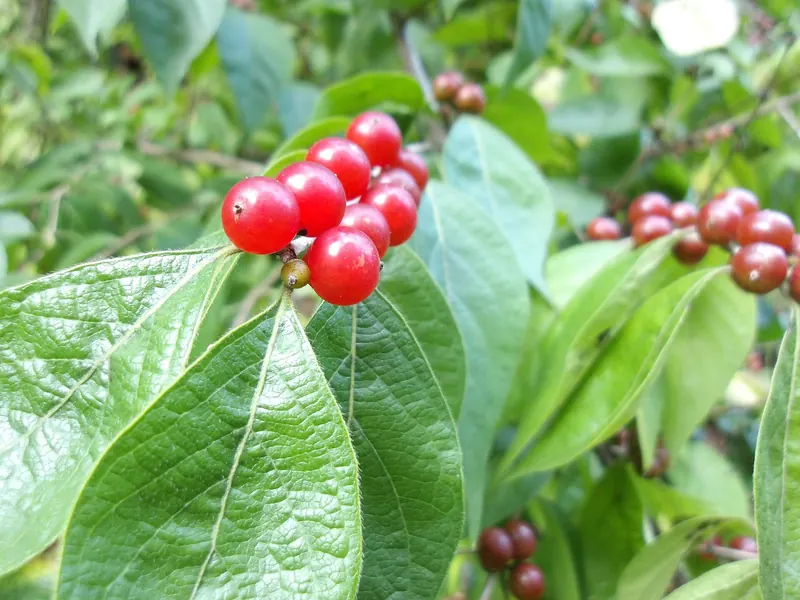
The vine with orange-and-red berries wrapped around your trees in October is almost always oriental bittersweet, the one invasive vine that kills a mature tree by itself; the hairy rope running up a trunk is poison ivy; the grape look-alike with berries in white, blue, purple and pink on one cluster is porcelainberry; and the rest of the tangle on a Southeast Michigan edge is wild grape and Virginia creeper, both native and both fine in moderation. That is the short field guide. Vines matter more than their size suggests because they do the one thing the shrubs skip: they climb, and a vine that reaches the crown of a tree shades it, loads it with weight and pulls it apart in the first ice storm.
This guide covers the invasive vines you meet on land in Oakland, Macomb, Wayne, Lapeer, Livingston, Genesee, Washtenaw and St. Clair counties, the three look-alike pairs that fool people, what each one does to a tree, a fence or an edge, and how a vine-choked tree line or fence row gets cleared with a forestry mulcher and a saw so it stays cleared. It pairs with our guide to poison ivy on trees and in winter and the worst invasive plants in Michigan.
The Vines You Meet on Southeast Michigan Land
| Vine | Native or invasive | How to know it | What it does |
|---|---|---|---|
| Oriental bittersweet | Invasive | Round to oval leaves with fine teeth; the flowers and fruit sit along the stem at the leaf joints; yellow-orange capsules split in fall to show red berries; woody vines to 60 feet that spiral around a trunk | Girdles and strangles trees, shades the crown, and brings the tree down under ice; the one vine that kills a mature tree on its own |
| Porcelainberry | Invasive | A grape look-alike: lobed leaves, forked tendrils, white pith when the stem is cut, and shiny berries in white, blue, purple and pink on one cluster in September | Blankets edges and fence rows; documented in several Oakland County locations |
| Japanese honeysuckle | Invasive | A twining vine with paired leaves that stay green into winter and fragrant white-to-yellow flowers in June; the shrub honeysuckles are a different plant | Smothers the understory and small trees; spreads by runners along the ground |
| Wintercreeper and English ivy | Invasive | Evergreen, climbing by rootlets; wintercreeper has opposite, toothed leaves, English ivy has alternate lobed leaves | Blankets the ground and the trunks, keeps the woods floor bare |
| Black swallow-wort | Invasive | A twining vine to 7 feet with glossy dark-green paired leaves, tiny purple-black star flowers in June, and milkweed-like pods that split in late summer | Takes over fields and edges; monarchs lay on it and the larvae die |
| Mile-a-minute weed | Invasive, a watch-for | Triangular leaves on thin green or red stems with recurved barbs, and pea-sized blue fruit in July; grows up to 25 feet in a summer | Found in Calhoun County in 2020 and Jackson County in the summer of 2026; the one to report if you find it |
| Wild grape (riverbank grape) | Native | Lobed leaves, shredding bark, brown center when cut, unforked tendrils, green-to-purple fruit | Heavy on small trees and fence wire; wildlife food; a nuisance, not an invader |
| Virginia creeper | Native | Five leaflets, climbs by tendrils with sucker pads, dark blue berries, red fall color | Harmless to a healthy tree; mistaken for poison ivy constantly |
| Poison ivy | Native | Three leaflets; as a vine, a hairy rope of aerial roots on the trunk, white berries in fall | Covered in its own guide: poison ivy on trees and in winter |
Three Look-Alike Pairs That Fool Everyone
Oriental bittersweet vs American bittersweet
Same orange capsules, same red berries. On the invasive one the fruit sits along the stem at every leaf joint; on the native American bittersweet it sits in a single cluster at the very tip of the branch. The invasive one is the one you find on a fence row; the native is uncommon enough that finding it is a good day.
Porcelainberry vs wild grape
Cut a stem. Porcelainberry has white pith; grape has a brown center. Porcelainberry tendrils fork; grape tendrils are single. Porcelainberry bark is smooth with white speckles; grape bark shreds. And the berries: porcelainberry ripens into a mix of white, blue, purple and pink on one cluster, grape into green and purple only.
Poison ivy vs Virginia creeper
Three leaflets against five, in summer. In winter, the climbing roots: poison ivy clings with a dense mat of hairlike aerial roots that makes the vine look furry; Virginia creeper clings with sparse tendrils that end in little sucker pads. Poison ivy berries are white; creeper berries are dark blue.
What a Vine Does to a Tree, a Fence and an Edge
A vine is a plant that spends nothing on a trunk and everything on reaching the light, so it climbs faster than the tree it is on can grow. Bittersweet wraps a young trunk so tightly that the trunk grows around it and is cut in two; on a mature tree it reaches the crown, shades the leaves and adds hundreds of pounds that the first ice storm turns into a lever. Grape and porcelainberry do the same more slowly and with less strangling. On a fence, the weight of any of them pulls the wire off the posts and lays the fence down; our guide to overgrown fence lines in Michigan covers how a fence row goes from a line to a band. On an edge, the ground-running vines, honeysuckle, wintercreeper and English ivy, keep the floor bare so nothing native comes up.
How a Vine-Choked Tree Line or Fence Row Gets Cleared
Vines are the one part of a clearing job that is done in two directions: up, with a saw, and across, with the machine. The extension guides on bittersweet agree on the order, and it is the order we use.
1. Cut the climbers at the base and at shoulder height
Every vine on a keeper tree is cut twice, once near the ground and once at about shoulder height, so a section comes out and the top dies in the crown. The dead top drops over the next year or two on its own; pulling a living bittersweet out of a crown breaks the limbs it is wrapped around.
2. Mulch the thicket below
The forestry mulcher takes the ground-running vines, the shrub layer they grew up through and the sapling weed trees they climbed down to the ground between the flagged keepers, and leaves chips instead of a tangle. The vines are easiest to find in October, when bittersweet fruit colors, and in winter, when the vines stand out on bare trunks.
3. Handle the fruit
A fruiting bittersweet or porcelainberry vine cut in fall is a seed packet. Fruiting sections are bagged rather than mulched, and fruiting vines are never used in a wreath, which is how bittersweet got around in the first place.
4. Cut the regrowth
Bittersweet, honeysuckle and porcelainberry sprout from the root crown the next summer. A mowing pass that summer and the next, or a cut-stump treatment the same day as the cut, finishes what the first pass started. The guide to stumps after forestry mulching explains why repeated cutting works.
5. Replant the edge
A cleared edge with nothing planted grows the next vine. Native shrubs that close the gap, hazelnut, gray dogwood, nannyberry, elderberry, and a sedge or wild-rye ground layer give the seed nothing to climb; see what to plant after removing buckthorn and honeysuckle.
On a fence row the same work is a corridor along the wire: the vines cut off the posts, the band of brush and weed trees mulched back to the line you flag, the keeper trees on the line left standing with their vines cut. Our fence line clearing and invasive growth removal pages cover the service.
When to Deal With Vines in Michigan
| Month | What you can see | What gets done |
|---|---|---|
| October | Bittersweet fruit at full color; porcelainberry berries; grape fruit; honeysuckle still green | The walk-through and the flagging; fruiting vines cut and bagged |
| November to March | Every vine on every trunk, with the leaves gone; the furry poison ivy ropes; evergreen wintercreeper and ivy | The main clearing: climbers cut, thicket mulched on frozen ground |
| April to May | Honeysuckle and wintercreeper green first; bittersweet leafing | Spring pull of seedlings on the edge cleared last year |
| June to July | Swallow-wort flowering, pods forming; mile-a-minute fruit in July | Mow swallow-wort before the pods open; pull mile-a-minute before fruit |
| August to September | Porcelainberry flowering and fruiting; bittersweet fruit green | Cut regrowth on cleared edges before the fruit ripens; stump treatments from now into fall |
Common Questions
What is this vine with red berries in the fall in Michigan?
Almost always oriental bittersweet: yellow-orange capsules that split to show red berries, sitting along the stem at every leaf joint, on a woody vine spiraling up a trunk or along a fence. The native American bittersweet carries its fruit only at the branch tips and is uncommon.
Is bittersweet killing my trees?
Yes, if it has reached the crown. It girdles young trunks, shades the leaves of mature trees and adds the weight that brings a tree down under ice. Cutting every vine twice, at the base and at shoulder height, stops it the day it is done; the dead top drops on its own.
How do I get rid of oriental bittersweet?
Cut the climbers at the base and shoulder height so the tops die, mulch the thicket below, bag any fruiting sections, then mow the root-crown sprouts the next two summers or treat the stumps the same day as the cut. Replant the edge with natives so the seed has nothing to climb.
What is the best time to cut vines?
Fall to find them, when bittersweet fruit colors, and winter to clear them, when every vine shows on a bare trunk and the ground is frozen. Vines cut in the dormant season sprout least. Regrowth is mowed in summer.
Is my wild grape actually porcelainberry?
Cut a stem. White pith, forked tendrils and smooth speckled bark are porcelainberry; a brown center, single tendrils and shredding bark are wild grape. In September the berries settle it: porcelainberry ripens into white, blue, purple and pink on one cluster.
Is wild grape invasive?
No, it is native and the fruit feeds wildlife. It is heavy on small trees and fence wire, so it gets cut back where it is pulling something down and left where it is not.
Can vines be mulched?
The ground-running vines and the thicket they grow through, yes: a forestry mulcher takes them down to the ground and leaves chips. The climbers on keeper trees are cut by hand first, so the keepers stay. Fruiting sections are bagged, not mulched.
Do you clear vines from trees and fence lines?
Yes. Vines on keeper trees are cut at the base and shoulder height, the thicket below is mulched, fruiting sections are bagged, and the regrowth gets a pass the next summer. It is part of a fence row, edge or woodlot clearing.
Sources and Further Reading
Identification features and the cut-twice method come from these extension and conservation pages; the Michigan detections from the state invasive species program. How we clear vines on our own jobs is stated in the text.
University of Connecticut, Integrated Pest Management: Invasive Plant Factsheet: Asiatic Bittersweet
North Carolina State University Extension: On the Lookout for Non-Native Invasive Plants: Oriental Bittersweet
Michigan Invasive Species Program: Oriental bittersweet
Oakland County Cooperative Invasive Species Management Area: Porcelainberry
Michigan Invasive Species Program: Mile-a-minute weed
Penn State Extension: Virginia Creeper and Poison Ivy: Identification with Control
Where We Do This Work
The work in this guide is done across eight Southeast Michigan counties from our base in Royal Oak. Every county page lists the townships we work in most, with a page for each.
Vines Pulling Down Your Trees or Your Fence?
We cut the climbers, mulch the thicket and come back for the regrowth. The quote is free.