
Tree of Heaven in Michigan: How to Identify It and Remove It in the Right Order
The Gibson Environmental Services crew
More than 10 years clearing land, cutting trails, and running forestry equipment in Southeast Michigan.
Tree of heaven is the fast-growing tree with the long, feather-like leaves that comes up along fence rows, behind garages and at the edge of vacant lots. One tree can drop hundreds of thousands of seeds in a year, and its roots send up new trunks well away from the parent. It is also the favorite host of the spotted lanternfly, which was first confirmed in Michigan in 2022.
This guide covers how to identify tree of heaven, how to tell it from the native trees it resembles, and why the order of the work matters more with this tree than with any other in our ten worst invasive plants guide.
Tree of Heaven at a Glance
| Tree of heaven | |
|---|---|
| Scientific name | Ailanthus altissima |
| Origin | Asia |
| Size | 40 to 65 feet tall, with a trunk 2 to 3 feet across |
| Leaves | 1 to 3 feet long, made up of 11 to 30 lance-shaped leaflets |
| Leaflet base | 1 to 5 small teeth, each tipped with a gland |
| Smell | Crushed leaves and broken twigs smell like rancid peanut butter |
| Bark | Thin, gray and smooth, with shallow cracks on older trunks |
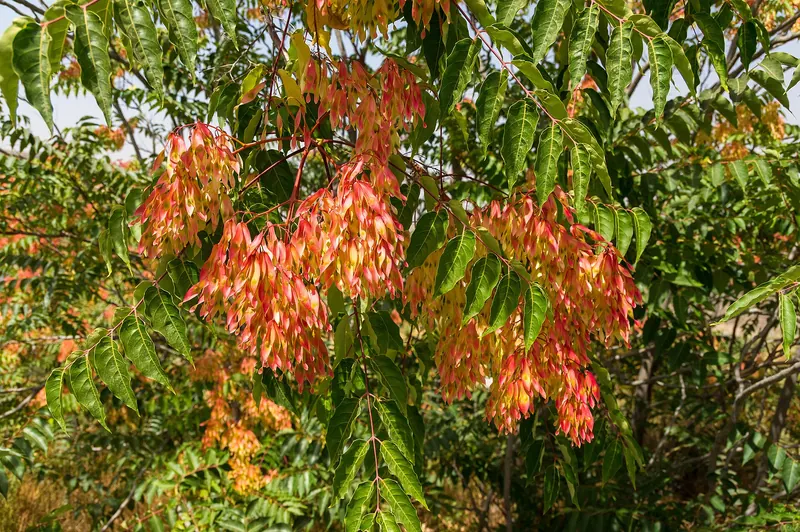
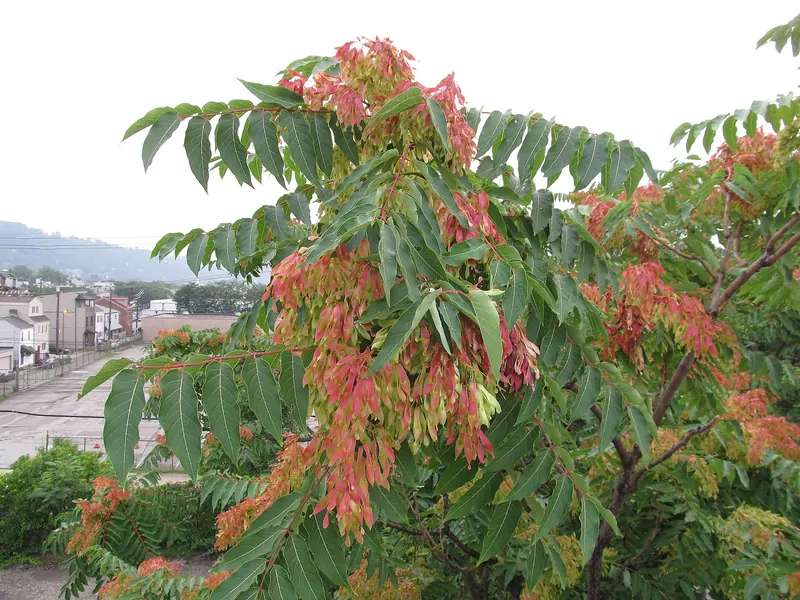
| Seeds | Papery and winged, reddish when ripe; up to 350,000 a year from one tree |
| Favorite ground | Fence rows, roadsides, fields, woods edges and poor soil in full sun |
How to Identify Tree of Heaven
The leaf
Each leaf is one to three feet long and made up of eleven to thirty narrow leaflets along a central stalk. The leaves alternate along the branch, are dark green above and pale below, and turn yellow in fall.
The teeth at the base of the leaflet
The edge of each leaflet is smooth except for one to five small teeth near the base, and each tooth carries a gland on its tip. No native look-alike has them.
The smell
Crush a leaf or break a twig. Tree of heaven smells like rancid peanut butter. It is the fastest test there is.
The twigs and bark
The twigs are very stout, light to dark brown and smooth, with large V-shaped scars where the leaves were attached. The bark is thin, gray and smooth, with shallow cracks on older trunks.
The seeds
Female trees carry clusters of flat, papery, winged seeds that turn reddish as they ripen and hang on into winter. Wind, water and birds carry them.
What Gets Mistaken for Tree of Heaven
Sumac
Staghorn and smooth sumac have the same long, many-leaflet leaf, but the leaflets are toothed along the whole edge and the fruit is an upright red cluster. There is no rancid smell.
Black walnut
Walnut leaflets are finely toothed all the way around, and the tree bears round nuts in a green husk. A crushed leaf smells spicy, not rancid.
Ash
Ash leaves sit opposite each other on the branch and have fewer leaflets. Tree of heaven leaves alternate.
Why Tree of Heaven Spreads
Seed by the hundred thousand
A single tree can produce up to 350,000 seeds in a year. They germinate readily and travel on the wind, on water and with birds.
One root system, many trunks
It spreads by suckers from the roots, so a stand of tree of heaven is often one plant with many trunks.
It likes the ground nobody else wants
It needs sun, and it thrives in poor and disturbed soil: fence rows, road edges, fill and the back corners of lots.
It works against its neighbors
Tree of heaven releases compounds that hold back the plants growing around it, and it grows very fast.
Cutting wakes it up
It resprouts after cutting, girdling, mowing and burning. Cut a healthy tree and the roots answer with new trunks.
Spotted lanternfly
Tree of heaven is the preferred host of the spotted lanternfly, an invasive insect first confirmed in Michigan in 2022. Knowing where the tree of heaven is on a property is the first step in watching for the insect.
The Order That Works
With most brush, clearing comes first and follow-up comes second. Tree of heaven is the other way around. The stand is treated while it is standing and in leaf, and cleared after it has died back, so the roots never get the signal to send up suckers.
| Step | What happens |
|---|---|
| 1. Find every stem | A stand is usually one root system. Every trunk and sucker in it is counted in, including the ones across the fence. |
| 2. Treat the standing trees | A treatment is applied to the stems in late summer or fall, when the tree is moving food down to its roots. |
| 3. Wait | The stand is left standing while the treatment works through the root system. |
| 4. Clear the dead stand | The dead trunks and the brush that grew up around them are taken down and mulched in place. |
| 5. Watch for suckers | Any sprouts that come up the next season are dealt with while they are small. |
Seedlings are the exception. A seedling less than about three months old has not grown its taproot yet and can simply be pulled by hand.
Clearing a treated stand, along with the fence row or lot it grew up in, is forestry mulching work. The forestry mulching page explains the method and the fence line clearing page covers the place tree of heaven turns up most.
When to Deal With Tree of Heaven in Michigan
Summer is the time to identify it, while the leaves and the seed clusters are on the tree.
Late summer and fall are when a standing tree is treated.
Winter and the following seasons are for clearing the dead stand and the brush around it.
What Tree of Heaven Removal Costs
Every job is one written project price, from photos or a walk-through, with the number and size of the trees, the brush around them, the access and the travel built in. The pricing guide explains what moves the number.
Common Questions
How do I tell tree of heaven from sumac or walnut?
Crush a leaf. Tree of heaven smells like rancid peanut butter. Then look at a leaflet: tree of heaven has a smooth edge with a few small teeth only at the base, while sumac and walnut leaflets are toothed all the way around.
Can I just cut a tree of heaven down?
Cutting a live tree of heaven brings up sprouts from the stump and suckers from the roots. Treating the stand first and clearing it after it has died back is what keeps one tree from becoming twenty.
Is tree of heaven connected to the spotted lanternfly?
Yes. It is the preferred host of the spotted lanternfly, an invasive insect first confirmed in Michigan in 2022.
How fast does tree of heaven spread?
Very fast. One tree can produce up to 350,000 seeds a year, and the roots send up suckers that turn a single tree into a stand.
When is the best time to deal with tree of heaven?
Identify it in summer, treat the standing trees in late summer or fall, and clear the dead stand after that. Winter is a good time for the clearing.
Can you tell what I have from photos?
Usually. Send a close photo of a leaf, one of a twig or cane, and one of the whole stand, and we will tell you what it is and how we would clear it.
Sources and Further Reading
The identification details and figures in this guide come from published university and state references. These are the ones to read for more depth.
University of Michigan Herbarium, Michigan Flora: tree-of-heaven (Ailanthus altissima)
Michigan Natural Features Inventory, Michigan State University Extension: A Field Identification Guide to Invasive Plants in Michigan's Natural Communities
Penn State Extension: Tree-of-heaven
USDA National Invasive Species Information Center: Tree-of-heaven
Where We Do This Work
The work in this guide is done across eight Southeast Michigan counties from our base in Royal Oak. Every county page lists the townships we work in most, with a page for each.
Tree of Heaven Coming Up Along a Fence Row or a Lot Line?
Send a few photos of the trees and the address. We will tell you what they are and lay out the order of the work, with one written price for the clearing.