
Get a Long Driveway Plow-Ready: The Brush to Cut Before the Snow
The Gibson Environmental Services crew
More than 10 years clearing land, cutting trails, and running forestry equipment in Southeast Michigan.
A long driveway closes in slowly, then all at once. Through the summer, saplings and edge growth lean in a little at a time, and the truck still fits, so nobody notices. Then the first heavy, wet snow lands on that growth and bends it across the lane.
This guide is for owners of long wooded or field-edge drives in Southeast Michigan. It covers what to walk and look for in the fall, how much room your machines need, and when to cut. Use it to do the work yourself or to decide when to call us. The driveway clearing page covers the service itself.
Why Long Driveways Close First
Length is the problem. A short drive gets driven and seen every day. A long one has a far end that nobody looks at until the weather turns.
Saplings bend under wet snow
Young stems are flexible. Wet snow loads them until they arc over the lane, and a frozen bend stays put until a thaw. A stem that stood clear in October can lie across the drive by December.
Field edges drift
Open ground beside a drive gives the wind nothing to stop it, so snow blows across and fills the lane. Growth at the edge catches that snow and stacks it right where the plow has to run.
Ice loads brush down
Freezing rain coats thin brush and weighs it down further than snow alone. Thick edge growth that looked fine in summer becomes a wall of bent stems after one ice storm.
Walk It Before the Ground Freezes
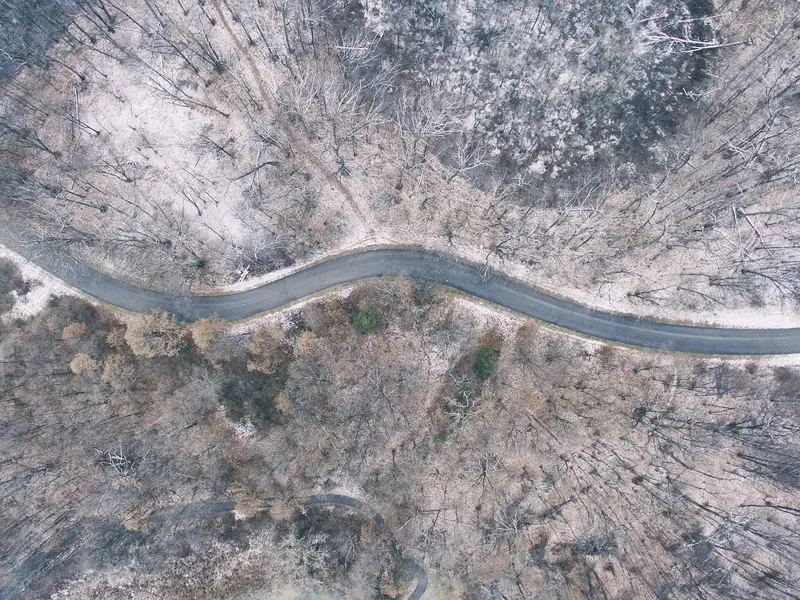
Walk the drive end to end on foot while the ground is bare and the edges are easy to see. Go slowly and look at it the way a plow driver will in a few weeks, in poor light, with the edges hidden. Take photos of each trouble spot as you go.
| What to look at | What you are looking for | What it means for winter |
|---|---|---|
| The narrowest stretch | Growth creeping in from both sides, or leaning across from one. | The first place a blade or truck rubs, and where snow piles up with nowhere to go. |
| Inside curves | Brush on the inside of each bend, blocking the view and the turning room. | A long truck and a blade swing wide in a curve. Growth on the inside gets hit or hangs the blade up. |
| Culvert and ditch ends | Brush grown over culvert ends or along the ditch beside the lane. | Under snow, brushed-in edges hide where the drive stops and the ditch starts. |
| The turnaround | Saplings filling the corners where vehicles turn. | With no room to turn, a driver has to back the whole drive out. |
| The gate | Growth crowding the posts or the swing of the gate. | A gate stuck partway open stays that way all winter, or takes a mirror off. |
| The mailbox and road end | Stems leaning in where the drive meets the road. | Snow pushed off the road and off the drive ends up here. Keep room for both. |
| The field side | Brush standing right at the lane edge across open ground. | It catches blowing snow and drops a drift on the lane. |
Flag each spot with tape or note it on your phone. That list is the job, and it is all we need to give you one written price.
How Much Room a Plow Needs
There is no single right width, because it depends on what uses your drive. Work it out from the machines. The lane should be wider than the widest thing that uses it, plus room to push snow.
A truck with a blade
The blade is set wider than the truck and angles to throw snow to one side. The drive needs room for the truck, the swing of the blade and a strip where the snow lands.
A tractor with a blade or bucket
A tractor works the snow in several passes. It wants more room to turn and to stack, and low brush on the edge catches in the bucket.
A snow blower
A blower throws snow in an arc well off to the side. Standing brush in that path catches it and drops it back on the lane.
A delivery truck
Fuel and freight trucks are wider and taller than a pickup, and their mirrors stick out. Stems leaning in at the top corner scrape the box even where the lane looks clear down low.
The Brush That Lies Down on the Drive
Start with young growth at the edge: sumac, buckthorn, autumn olive, box elder, willow and thorny brush. It closes a lane first because it is thin and flexible, and it grows fastest on the sunny edge where the drive opens the canopy.
A stem that leans a little in summer lies flat under snow. Cutting it low removes the leverage snow uses.
Brush hogging takes grass, weeds, brush and saplings up to about 3 inches thick and cuts a few inches above the ground. For a drive with a mowable edge, that is often all it needs. See our brush hogging page.
Open Fields and Drift Lines
Where a drive crosses open ground or runs beside a field, the wind decides where snow ends up. Snow drops out where moving air slows down, and growth at the lane edge slows it.
Cut back the lane edge
Growth standing right at the lane drops its drift on the lane. Cutting it back moves that pile away from where the plow runs.
Leave room to pile snow
A plow has to put the snow somewhere. A clear strip beside the lane gives it a place. A brush wall on both sides leaves nowhere but the lane.
Fence lines along the drive
Where a fence or hedgerow follows the drive, growth tangles into it and holds snow. The fence line clearing page covers that work.
Ditches, Culverts and Low Spots
Once snow covers the ground, lane, shoulder and ditch all turn the same white, and drivers read the edge growth to tell where the drive is.
Culvert and ditch ends
When brush hides a culvert end, the drive looks wider than it is and a wheel drops in. Cut the edges back in the fall, while you can still see where the ends are.
Low spots
Brush around a low spot holds water and shade, so ice stays longer on the lane. Opening it up lets the spot dry out.
What a Mulcher Does Along a Driveway
Forestry mulching is the right fit when the edge growth is thick, tall or mixed with young trees. We run a FECON drum mulcher on a high-flow tracked skid steer. It grinds brush and trees up to roughly 6-8 inches at the stem, grinds stumps flush, and leaves a chip layer typically 2-4 inches deep.
Along a drive, that is one pass down each side. The machine rides on rubber tracks and works from the lane itself, and we cut the strip you mark. The chips stay at the edge, where they hold the soil. Nothing is piled, hauled or burned, so there is no brush pile left to lean into the lane.
Our brush removal page explains the method, and the guide to the chip layer covers what the chips do.
Before the Freeze or After
A fall pass
The ground is firm, the leaves are down and every stem is easy to see. The drive is open before snow ever lies on it, and you can see how the lane runs.
A frozen-ground pass
Wet corners and ditch edges that are soft in fall firm up once the ground freezes, and a tracked machine works across them. A drive with wet spots is a good winter job.
Waiting for the first storm costs you the clear view, because snow hides the edges and bends the stems. Our fall and winter clearing guide covers both seasons.
Keeping It Clear Year After Year
Many of the species that were cut send up shoots the next season, so a cleared edge needs a simple rhythm.
Walk it every fall
Use the same walk and the same checklist. A short pass with your phone shows where growth has come back.
Cut the edge one or two times a year
Brush hogging one or two cuts a year keeps shoots and new saplings thin enough to cut easily. Our property maintenance page covers keeping a cleared edge on a schedule.
Reset it when it gets ahead of you
If a few seasons slip by and the stems have grown thicker than a rotary cutter takes, one forestry mulching pass resets the edge. Then the yearly rhythm starts again.
Driveway Clearing Across Southeast Michigan
We work from a base in Royal Oak across Oakland, Macomb, Wayne, Livingston, Lapeer, St. Clair, Washtenaw and Genesee counties. We clear drives like this around Metamora, Dryden and Attica in Lapeer County; Ortonville, Oxford, Addison, Brandon and Holly in north Oakland; Hartland, Howell and Pinckney in Livingston; Goodrich and Davison in Genesee; and Dexter and Chelsea in Washtenaw.
Each county page has the local detail: Lapeer County, Oakland County and Livingston County.
Common Questions
When should I cut the brush along my driveway?
In the fall, after the leaves are down and before the ground freezes and the first heavy snow comes. The edges are easy to see and the stems are cut before snow can bend them. A frozen-ground pass also works well, especially where the edges are wet.
How wide does my driveway need to be for a plow?
It depends on the widest machine that uses it. Take that vehicle, add room on each side for the snow to land, and clear to that line.
Will cutting the brush make the drive drift more?
Growth right at the lane edge drops its drift on the lane, so cutting it back usually moves the pile away from where the plow runs. Across open fields, a clear strip beside the lane matters most, because the snow needs somewhere to go.
Will the brush grow back?
Some of it will. Buckthorn, willow and box elder send up shoots from the cut stumps the next season. One or two cuts a year keep those shoots small.
How do I get a price?
Send a few photos of the drive and the address, or we can walk it with you. You get one written project price, travel included. Calls are answered 8 AM to 8 PM seven days a week, and forms and texts are answered within one business day.
Where We Do This Work
The work in this guide is done across eight Southeast Michigan counties from our base in Royal Oak. Every county page lists the townships we work in most, with a page for each.
Want the Driveway Opened Up Before the First Storm?
Send a few photos of the drive and the address. We will tell you what we would cut back and give you one written price, travel included.