
Phragmites in Michigan: How to Tell Invasive From Native, and What Actually Controls It
The Gibson Environmental Services crew
More than 10 years clearing land, cutting trails, and running forestry equipment in Southeast Michigan.
Phragmites is the tall, feather-topped reed that lines roadside ditches, retention ponds and lake shores across Southeast Michigan. A stand runs six to thirteen feet tall and so dense that nothing else grows in it. Michigan also has a native phragmites, a quieter plant that belongs here, and the first job is telling the two apart.
This is an information guide. It covers how to identify invasive phragmites, how it spreads, what makes a stand worse, and the sequence land managers use to bring one under control. It is one of the plants in our ten worst invasive plants guide.
Invasive or Native? The Side-by-Side
| Invasive phragmites | Native phragmites | |
|---|---|---|
| Scientific name | Phragmites australis subsp. australis | Phragmites australis subsp. americanus |
| The stand | A dense wall of stems | Scattered stems mixed in with other plants |
| Height | 6 to 13 feet | Generally shorter |
| Lower stem | Dull and yellowish, usually covered by the leaf sheath | Exposed, shiny and often reddish |
| Leaf sheaths | Stay wrapped on the stem after it dies | Fall off easily |
The stem test is the one to use in winter: pull the leaf sheath back on a dead stalk. If it clings and the stem under it is dull tan, the stand is invasive. If the sheaths have already dropped and the lower stem is smooth, shiny and reddish, it is likely the native.
How to Identify Invasive Phragmites
Height and density
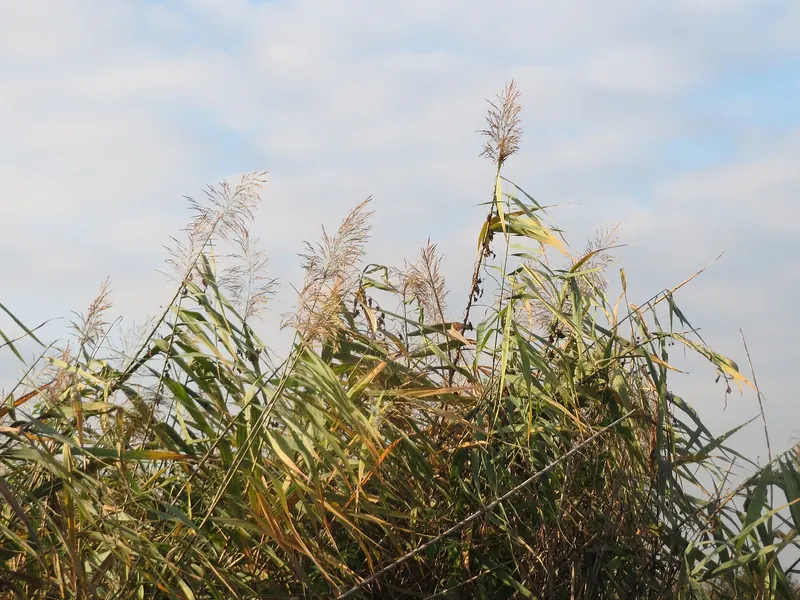
Six to thirteen feet tall, in a stand so tight that the stems touch. It is much taller than almost any other grass in Michigan.
The plume
Each stem ends in a dense, branched flower head that opens into a feathery plume as it matures.
The leaves
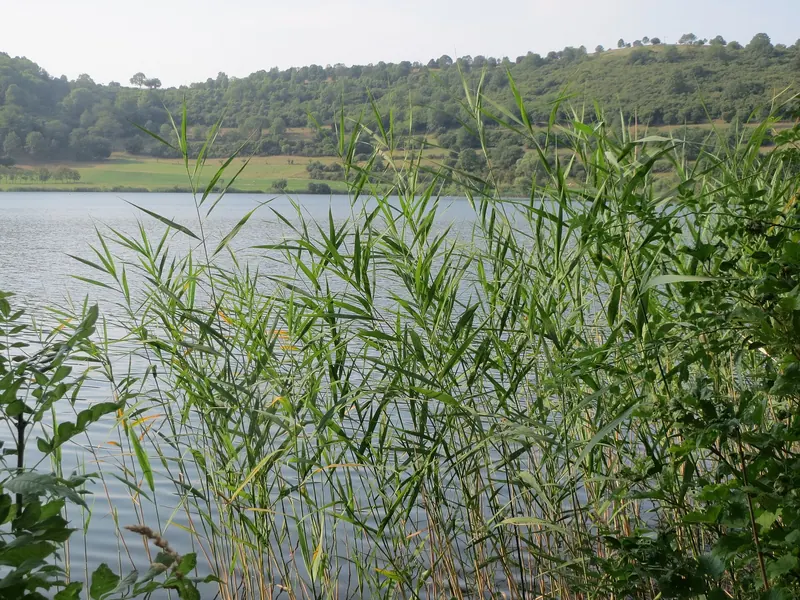
Flat, smooth leaf blades ten to twenty inches long and up to about an inch and a half wide, coming off the stem all the way up.
The stems
Upright, rigid and hollow, dull yellowish in color, and usually hidden by the leaf sheaths.
In winter
The dead stalks and plumes stand all winter with the leaf sheaths still wrapped around them, which is why a stand looks the same in January as it did in October.
What Gets Mistaken for Phragmites
Native phragmites
The same species, a different subspecies, and a plant that belongs in Michigan wetlands. It grows as scattered stems, not a wall. Use the side-by-side above before anything is done to a stand.
Reed canary grass
Similar leaves on a much shorter grass, without the big feathery plume.
Wild rice
Tall, but it lacks the feathery look, and it grows in the water.
Cattails
Flat, strap-like leaves that rise from the base, and a brown, sausage-shaped head. No plume.
Where It Shows Up
Invasive phragmites grows in wetlands, ditches, swales, and along stream and pond banks. It tolerates road salt and responds quickly to nutrient-rich runoff, which is why it follows roads and drains and turns up first where a ditch or a storm pipe empties into a pond.
In Southeast Michigan that means roadside ditches, subdivision retention ponds, county drains, lake shores and the low corners of fields.
How Phragmites Spreads
By seed
It is a prolific seeder, and it spreads readily by seed. New stands far from any other phragmites usually started this way.
By rhizome
An aggressive system of underground stems runs sideways and straight down from every stand. The rhizomes can live three to six years.
By the piece
A piece of rhizome carried in soil, or on a mower or an excavator, can start a new stand wherever it lands.
What Makes a Stand Worse
Burning, mowing, disking and digging, done on their own, can stimulate a stand. Mow a green stand in summer and it tends to come back thicker from the rhizomes. Dig it and the rhizomes are broken into pieces, each one able to grow.
This is the single most useful thing to know about phragmites: the obvious first move is usually the wrong one.
The Sequence That Controls It
A large, dense stand is brought down with a treatment applied to the green plants in late summer or fall, followed by removal of the dead stalks, repeated until the stand stops coming back.
| When | What is done | Why |
|---|---|---|
| Late summer to fall | The green stand is treated | The plant is moving food down to its rhizomes, and the treatment goes with it |
| Winter | The dead stalks are cut or mowed | Clears the standing dead material and lets light reach the ground |
| Next summer | The site is checked for regrowth | Shows how much of the rhizome system survived |
| Late summer again | Regrowth is treated | Each round leaves less |
| The years after | A yearly check | Rhizomes live three to six years and seed keeps arriving |
Cutting and clearing the dead stalks is winter work, done on frozen ground so the site is not rutted. It is the same kind of work described on the invasive growth removal page and the retention pond clearing page.
What a Property Owner Can Do
Learn the two apart
Check the stand against the side-by-side above. The native plant is worth keeping.
Catch it small
A patch the size of a parking space is a far easier job than a stand the size of a lot. New patches near a ditch outlet or a road edge are the ones to watch.
Leave the green stand unmowed
Mowing in summer spreads pieces and thickens the stand. Mowing belongs in winter, after the stand has been treated.
Keep soil and equipment clean
Soil from a stand carries rhizome pieces. So do mower decks and buckets.
Work with the neighbors
A stand does not stop at the lot line. Ponds and shorelines are handled best when the whole association or the whole shore does it together.
Common Questions
How do I tell invasive phragmites from the native kind?
Look at the stand and the stem. Invasive phragmites grows as a dense wall, its lower stems are dull and yellowish, and the leaf sheaths stay on the dead stalks. Native phragmites grows as scattered stems that are shiny and often reddish near the base, and its leaf sheaths fall off easily.
Does mowing get rid of phragmites?
Not by itself. Mowing a green stand in summer tends to bring it back thicker from the rhizomes. Mowing has its place in winter, to take down the dead stalks of a stand that has already been treated.
How long does it take to control a stand?
Plan on several years. The rhizomes can live three to six years and seed keeps arriving, so a stand is treated and checked each year until it stops coming back.
Does phragmites spread by seed or by roots?
Both. It is a prolific seeder, and it spreads through underground stems that run out from every stand. Pieces of those stems moved in soil or on equipment start new stands.
Why is phragmites along every road?
It tolerates road salt and responds quickly to nutrient-rich runoff, and ditches carry both. Ditch and roadside equipment also moves pieces of the plant from one place to the next.
Can you tell what I have from photos?
Usually. Send a photo of the whole stand, a close one of the lower stem with the leaf sheath pulled back, and one of the seed head.
Sources and Further Reading
The identification details and figures in this guide come from published university and state references. These are the ones to read for more depth.
University of Michigan Herbarium, Michigan Flora: reed (Phragmites australis)
Great Lakes Phragmites Collaborative: Native vs. non-native phragmites and management
Michigan Natural Features Inventory, Michigan State University Extension: A Field Identification Guide to Invasive Plants in Michigan's Natural Communities
USDA National Invasive Species Information Center: Common reed
Where We Do This Work
The work in this guide is done across eight Southeast Michigan counties from our base in Royal Oak. Every county page lists the townships we work in most, with a page for each.
Not Sure What Is Growing in Your Ditch or Along Your Shore?
Send a few photos and the address. We will tell you what it is and what the next step would be.