
Multiflora Rose in Michigan: How to Identify It and Get It Out of a Pasture
The Gibson Environmental Services crew
More than 10 years clearing land, cutting trails, and running forestry equipment in Southeast Michigan.
Multiflora rose is the thorny, arching thicket that takes a pasture corner, then the fence row, then the field. It was brought in as a living fence and for erosion control, and it does both jobs too well: one plant can spread ten feet or more across, and the thorns hook anything that brushes past. We clear it most often in the horse and farm country of Lapeer, northern Oakland, Livingston and St. Clair counties.
This guide covers how to identify multiflora rose, how to tell it from the native roses, why it is so hard to get out of a pasture, and what it takes to clear it and keep it out. It is one of the plants in our ten worst invasive plants guide.
Multiflora Rose at a Glance
| Multiflora rose | |
|---|---|
| Scientific name | Rosa multiflora |
| Origin | Japan and Korea; brought in during the 1800s |
| Size | To 16 feet tall and 10 feet or more across, with long arching canes |
| Leaves | Alternate, with 5 to 11 finely toothed leaflets about an inch long |
| Canes | Green to reddish, with stout curved thorns |
| Flowers | White or slightly pink, five petals, in clusters, May and June |
| Fruit | Small, hard, red rose hips from September on, lasting into winter |
| Seed life in the soil | 10 to 20 years |
| Favorite ground | Pasture, fence rows, roadsides, stream banks, woods edges |
How to Identify Multiflora Rose
The fringe at the base of the leaf
Where the leaf stalk meets the cane there is a small green collar with a fringed, comb-like edge. Native roses do not have the fringe. It is the surest way to tell multiflora rose from any other rose.
The leaves
Each leaf is made up of five to eleven small leaflets, about an inch long, with finely toothed edges. The leaves alternate along the cane.
The canes and thorns
Long, slender canes arch up and over, green to reddish, with stout thorns that curve backward. A cane that reaches the ground can take root at the tip and start a new plant.
The flowers
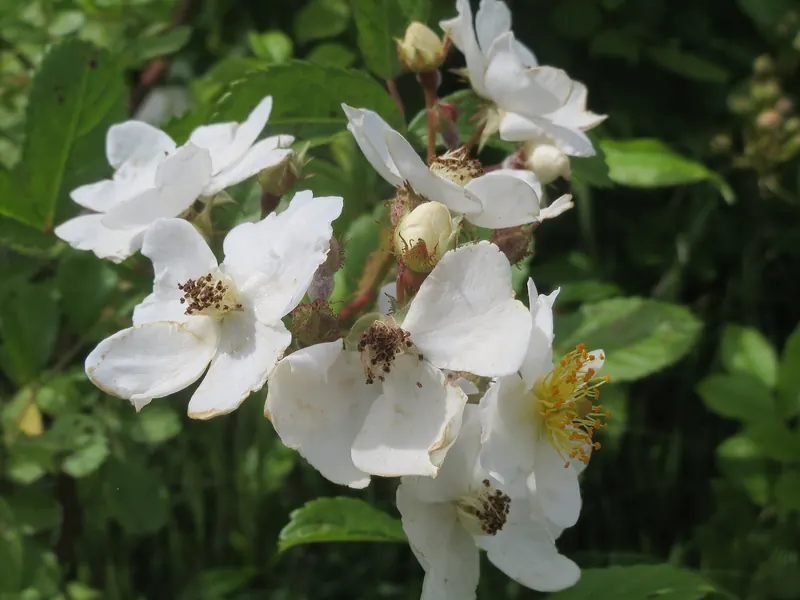
Clusters of white, five-petaled flowers, sometimes with a touch of pink, in May and June. Late spring, while it is in bloom, is the easiest time to spot it.
The hips
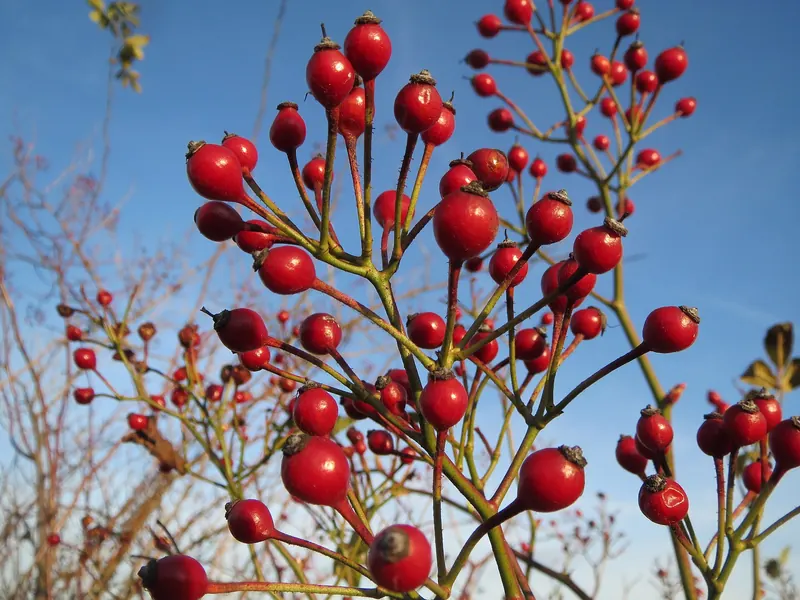
Small, hard, smooth red hips in clusters from September on. They last into winter and stand out against the snow.
What Gets Mistaken for Multiflora Rose
Native roses
Michigan's native roses have pink flowers and no fringe at the base of the leaf. Swamp rose, the one most often confused with multiflora rose, has curved thorns with a broad base and grows in wet ground.
Blackberry and raspberry
Thorny, arching canes as well, but the leaves have three to five larger leaflets, there is no fringe at the base of the leaf, and the fruit is a berry, not a hard red hip.
Why Multiflora Rose Is Hard to Get Out of a Pasture
It was planted on purpose
It was promoted for erosion control, as a living fence, and for wildlife food and cover, so it was set out along the same field edges it now takes over.
It spreads three ways
By seed, by canes that root where they touch the ground, and by cane tips that root and start new plants. One shrub becomes a thicket without any help.
The seed waits
Multiflora rose seed stays alive in the soil for ten to twenty years. Clearing the thicket is the start of the job; keeping the seedlings mowed is the rest of it.
Birds and animals carry the hips
The hips last into winter, when there is little else to eat, and the seed goes wherever the birds and animals go.
Livestock graze around it
Horses and cattle leave the thorns alone, so every year the thicket is a little wider and the pasture a little smaller.
How to Remove Multiflora Rose, by the Size of the Problem
Small plants
Dig them out and get all of the root. A young plant comes up easily when the soil is moist.
A few clumps
Cut the canes at the ground. The crown resprouts, so plan on a treatment of the cut stems, or on cutting or mowing the regrowth several times through the growing season until the root is spent.
A pasture corner, a fence row or acres of it
This is forestry mulching work. The mulching head grinds the canes and the crowns where they stand, so nobody has to handle thorny brush and there are no piles to burn. The pasture reclamation page and the fence line clearing page cover the two places it turns up most.
Keeping it pasture
Mowing is what finishes multiflora rose. A few brush hogging passes through the growing season for the first couple of years, then regular pasture mowing, keeps seedlings from ever becoming thickets.
The Follow-Up Plan
| When | What the rose does | What keeps it down |
|---|---|---|
| The day it is cleared | Thickets are ground to a chip layer | The fence line and the field edge are open again |
| First season | Crowns resprout; seedlings come up from the seed bank | Mow two or three times through the growing season |
| Second and third seasons | Weaker sprouts, more seedlings | Keep mowing; pasture grass closes over |
| The years after | Seed in the soil lasts 10 to 20 years | Regular pasture mowing |
When to Remove Multiflora Rose in Michigan
Late spring, while it is in bloom, is when it is easiest to find every plant in a field.
Summer and fall are good for clearing pasture and fence rows. On a horse farm the work is scheduled around turnout, one paddock at a time.
Winter on frozen ground is the time for stream banks and wet corners.
What Multiflora Rose Removal Costs
Every job is one written project price, from photos or a walk-through, with the acreage, the density of the thickets, the fence rows and the travel built in. Mowing visits afterward are priced the same way. The pricing guide explains what moves the number.
Common Questions
How do I tell multiflora rose from a wild rose?
Look where the leaf stalk meets the cane. Multiflora rose has a small collar there with a fringed, comb-like edge, and its flowers are white. Native roses have no fringe and their flowers are pink.
Will multiflora rose come back after forestry mulching?
The crowns will try, and seedlings will come up from the seed in the soil. Mowing two or three times through the first seasons handles both, and regular pasture mowing after that keeps it out.
How long does multiflora rose seed last?
Ten to twenty years in the soil. That is why mowing after the clearing matters more with this plant than with almost any other.
Can you clear it with horses on the property?
Yes. We schedule around turnout and take one paddock at a time, with the horses moved to the far field while the machine is working.
What is the best time of year to clear multiflora rose?
Any time the ground will carry the machine. It is easiest to find in late spring while it is blooming, and wet corners are cleared on frozen ground in winter.
Can you tell what I have from photos?
Usually. Send a close photo of a leaf, one of a twig or cane, and one of the whole stand, and we will tell you what it is and how we would clear it.
Sources and Further Reading
The identification details and figures in this guide come from published university and state references. These are the ones to read for more depth.
University of Michigan Herbarium, Michigan Flora: multiflora rose (Rosa multiflora)
Michigan Natural Features Inventory, Michigan State University Extension: A Field Identification Guide to Invasive Plants in Michigan's Natural Communities
USDA National Invasive Species Information Center: Multiflora rose
Where We Do This Work
The work in this guide is done across eight Southeast Michigan counties from our base in Royal Oak. Every county page lists the townships we work in most, with a page for each.
Multiflora Rose Taking Over a Pasture or a Fence Row?
Send a few photos of the growth and the address. We will tell you what it is, how we would clear it, and give you one written price for the job.